Childbirth is a big moment, and many mothers-to-be worry most about labour pain. Today, doctors can offer safe ways to ease that pain while the mother stays awake and takes part in the birth. This guide explains how epidural pain relief works, what you can expect, and how to talk to your doctor about it.
What Is Painless Normal Delivery?
Many mothers ask about painless normal delivery when they want a vaginal birth with less pain. In simple words, it means a vaginal birth where the doctor uses medicine to reduce labour pain. The most common method is epidural analgesia, and analgesia just means pain relief. You may also hear this approach called painless labour.
It is important to know that painless delivery does not mean a C-section. A painless vaginal delivery means the baby is still born through the birth canal. Pain relief eases the sharp pain of contractions, but you may still feel pressure, tightness or movement. No doctor can promise a labour with no sensation at all. Whether a vaginal birth is right for you depends on your health and your baby’s condition, and your doctor will guide you at each stage.
How Does Painless Normal Delivery Work?
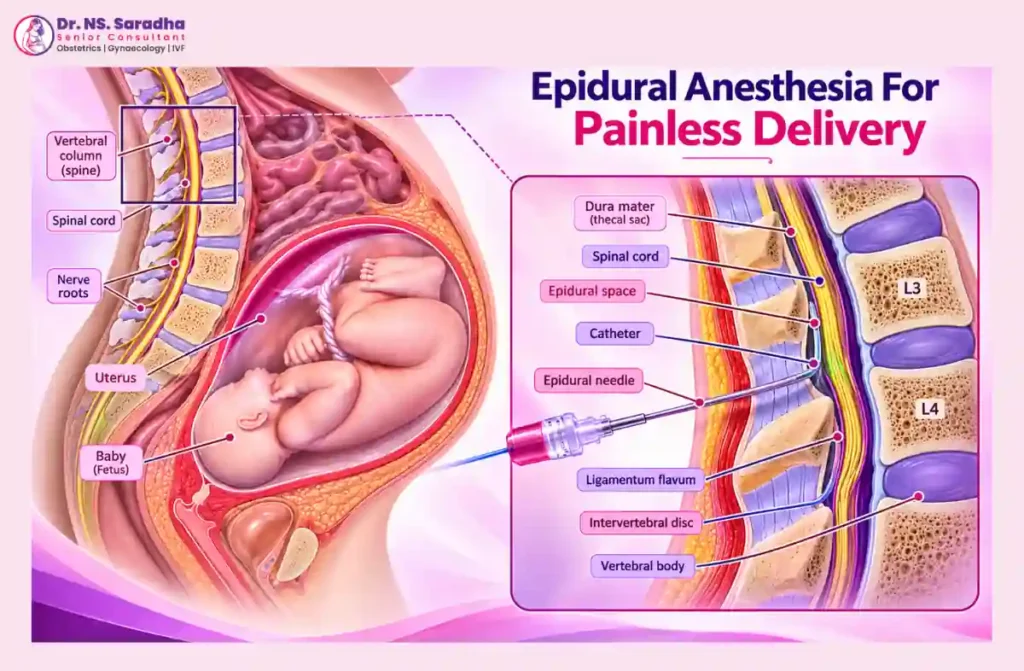
The steps involved in painless normal delivery are carried out by an anaesthesiologist, a doctor trained in anaesthesia and pain relief, together with your obstetrician. In simple terms, this is how the procedure usually goes:
- The medical team checks your health, your baby’s wellbeing and how your labour is progressing.
- You sit up and lean forward, or lie on your side, so your lower back is easy to reach.
- The skin on your lower back is cleaned and prepared.
- A local anaesthetic is given to numb the small area where the needle will go.
- A thin needle is used to place a very small, soft tube, called a catheter, in the epidural space. This is the space just outside the sac that surrounds the spinal cord.
- The needle is removed, the tube stays in place, and pain-relief medicine is given through it.
- The anaesthesiologist adjusts the medicine to match your comfort.
- You and your baby are monitored throughout labour.
You usually stay awake and alert during the whole procedure. Before it starts, the team explains what will happen, answers your questions and asks for your consent. An intravenous line is often placed, and your blood pressure is checked. While the tube is placed, you may feel a pinch from the local anaesthetic and a little pressure. You will be asked to stay still, and the team will guide you.
After the medicine starts working, an epidural during labour makes contractions feel much less sharp. Your legs may feel warm, heavy or a little numb. Your blood pressure and your baby’s heartbeat are checked regularly, and some mothers need a thin tube to help pass urine. Once the baby and the placenta are delivered, the medicine is stopped and the tube is removed. Normal feeling in the lower body usually returns within a few hours.
When Can You Choose Epidural Pain Relief During Labour?
There is no single right moment for everyone. The best time to start epidural pain relief during delivery depends on how your labour is progressing, how you and your baby are doing, and your own comfort. This is why your obstetrician and anaesthesiologist assess you before deciding.
Because the decision is personal, it helps to talk about pain management during your antenatal visits, so you can make calmer choices on the day.
Benefits of Painless Normal Delivery
For many mothers, painless normal delivery can make a long labour easier to handle. The common benefits of painless delivery include less pain and discomfort, a chance to rest between contractions, and a calmer mind. Because you stay awake, you can still take part in the birth and hear your baby’s first cry. For mothers whose labour pain is hard to cope with, it can be a helpful choice. Every labour is different, so experiences and results vary from one mother to another.
Possible Side Effects and Risks of Epidural Anaesthesia
Like any medical procedure, epidural pain relief has some possible effects. Most are mild and can be managed by the care team, and not every mother will have them. The side effects of epidural anaesthesia can include a temporary drop in blood pressure, shivering, itching, nausea or a mild fever. Some mothers feel heaviness in the legs, or have trouble passing urine for a short time. A headache can happen in some cases. Sometimes the pain relief is uneven or only partial, and the dose may need to be adjusted. Rare problems, such as infection or nerve-related problems, have also been reported.
This is why you and your baby are watched closely after the epidural is placed. If your blood pressure drops or you feel unwell, the team can respond quickly with fluids, medicine or a change in the dose. Your doctors will explain the risks that matter for your own health before you decide.
Who Can Consider Painless Normal Delivery?
An epidural may suit many women, but each mother needs her own assessment. Women who may consider painless normal delivery include first-time mothers, mothers whose labour is taking a long time, and those who prefer medical pain relief. Some mothers with certain health conditions may also benefit, when the obstetrician includes pain management in the care plan.
Some situations need extra checks, or may make an epidural unsuitable. These include:
- Certain blood-clotting disorders
- Low platelet counts
- Some blood-thinning medicines
- An infection near the injection site
- Certain spinal conditions or earlier back surgery
This is not a complete list of medical rules. The anaesthesiologist makes the final decision after looking at your health history and test results.
Painless Labour vs Normal Delivery: What Is the Difference?
The two terms are often mixed up, but they describe different things. Painless labour is a way of managing pain. Normal delivery is a way of giving birth, meaning a vaginal birth. A woman can have a vaginal delivery with or without epidural pain relief. Normal delivery with epidural simply means a vaginal birth where epidural pain relief is also used.
| Point | Painless labour | Normal delivery |
|---|---|---|
| Meaning | A pain-relief approach used during labour | Childbirth through the birth canal |
| Pain management | Epidural or similar medicine eases contraction pain | Pain is managed with natural methods, or with medicine if needed |
| Mother’s awareness | Awake and alert | Awake and alert |
| Delivery method | Usually a vaginal birth | A vaginal birth |
| Medical support | Anaesthesiologist and obstetrician work together | Obstetrician and labour team |
| Possible experiences | Less sharp pain, but pressure may remain; legs may feel heavy | Contraction pain is felt more fully; mobility is usually easier |
Other Ways to Manage Labour Pain
An epidural is only one choice. Many mothers use other methods on their own or along with medical care. Slow breathing and relaxation can help you stay calm between contractions. Walking and changing positions, when your doctor agrees, may ease discomfort. Massage and supportive touch from a partner or family member can also help, as can a warm shower where it is available and suitable. Your healthcare team may also suggest other medical options for pain relief during childbirth. These methods give different levels of relief, so labour pain management should be chosen according to your needs and medical condition.
How to Prepare for Painless Normal Delivery
Good preparation makes childbirth feel less stressful. Start with regular antenatal check-ups with your obstetrician in Chennai, and tell your doctors about your medical history, allergies, current medicines and any earlier spinal procedures. You can also read about obstetric care and healthy eating in pregnancy while you wait for your appointment. A flexible birth plan works best, because labour does not always follow the plan. Follow your doctor’s advice about food, fluids and activity once labour begins.
It also helps to bring questions to your visit. You may want to ask:
- Is an epidural suitable for me, based on my health and tests?
- Will an anaesthesiologist be available when I am in labour?
- When is the right time to start the epidural?
- What side effects should I expect, and how will they be managed?
- What other pain-relief options do I have if an epidural is not suitable?
- What happens if my plan needs to change during labour?
Common Myths About Painless Normal Delivery
- Myth: Painless delivery always leads to a C-section. Fact: Epidural pain relief is meant to support a vaginal birth. Whether a C-section is needed depends on the mother’s and baby’s condition, not only on the epidural.
- Myth: An epidural means the mother will be unconscious. Fact: Most mothers stay awake and alert. The medicine numbs pain in the lower body and does not put you to sleep.
- Myth: An epidural removes every sensation. Fact: It lowers pain, but you may still feel pressure, tightness or movement during labour.
- Myth: An epidural always causes permanent back pain. Fact: Some soreness at the injection spot can happen for a short time. Back pain is also common after pregnancy and delivery, with or without an epidural.
- Myth: Every pregnant woman can have an epidural. Fact: Some health conditions need extra checks or make it unsuitable. Your doctors will decide after assessing you.
Painless Normal Delivery Care with Dr. N.S. Saradha in Chennai
Dr. N.S. Saradha is a Senior Consultant in Obstetrics, Gynaecology and IVF with more than 30 years of experience in women’s healthcare. Her website lists pre-pregnancy counselling, regular antenatal care, high-risk pregnancy care, childbirth care including painless delivery, and post-delivery care. If you are looking for pregnancy care in Chennai, you can meet her at SIMS Hospitals, Vadapalani, or at Agna Clinic, Saligramam.
During a consultation, she can talk through your delivery options, including painless normal delivery, and help you plan your birth in a way that suits your health. Guidance on labour pain management is part of this conversation, and the plan is shaped by how you and your baby are doing. Safe pain relief also depends on good teamwork between the obstetrician and the anaesthesiologist, so these discussions happen before labour whenever possible. Mothers planning a normal delivery in Chennai can also read about Childbirth is a big moment, and many mothers-to-be worry most about labour pain. Today, doctors can offer safe ways to ease that pain while the mother stays awake and takes part in the birth. This guide explains how epidural pain relief works, what you can expect, and how to talk to your doctor about it.
What Is Painless Normal Delivery?
Many mothers ask about painless normal delivery when they want a vaginal birth with less pain. In simple words, it means a vaginal birth where the doctor uses medicine to reduce labour pain. The most common method is epidural analgesia, and analgesia just means pain relief. You may also hear this approach called painless labour.
It is important to know that painless delivery does not mean a C-section. A painless vaginal delivery means the baby is still born through the birth canal. Pain relief eases the sharp pain of contractions, but you may still feel pressure, tightness or movement. No doctor can promise a labour with no sensation at all. Whether a vaginal birth is right for you depends on your health and your baby’s condition, and your doctor will guide you at each stage.
How Does Painless Normal Delivery Work?
The steps involved in painless normal delivery are carried out by an anaesthesiologist, a doctor trained in anaesthesia and pain relief, together with your obstetrician. In simple terms, this is how the procedure usually goes:
- The medical team checks your health, your baby’s wellbeing and how your labour is progressing.
- You sit up and lean forward, or lie on your side, so your lower back is easy to reach.
- The skin on your lower back is cleaned and prepared.
- A local anaesthetic is given to numb the small area where the needle will go.
- A thin needle is used to place a very small, soft tube, called a catheter, in the epidural space. This is the space just outside the sac that surrounds the spinal cord.
- The needle is removed, the tube stays in place, and pain-relief medicine is given through it.
- The anaesthesiologist adjusts the medicine to match your comfort.
- You and your baby are monitored throughout labour.
You usually stay awake and alert during the whole procedure. Before it starts, the team explains what will happen, answers your questions and asks for your consent. An intravenous line is often placed, and your blood pressure is checked. While the tube is placed, you may feel a pinch from the local anaesthetic and a little pressure. You will be asked to stay still, and the team will guide you.
After the medicine starts working, an epidural during labour makes contractions feel much less sharp. Your legs may feel warm, heavy or a little numb. Your blood pressure and your baby’s heartbeat are checked regularly, and some mothers need a thin tube to help pass urine. Once the baby and the placenta are delivered, the medicine is stopped and the tube is removed. Normal feeling in the lower body usually returns within a few hours.
When Can You Choose Epidural Pain Relief During Labour?
There is no single right moment for everyone. The best time to start epidural pain relief during delivery depends on how your labour is progressing, how you and your baby are doing, and your own comfort. This is why your obstetrician and anaesthesiologist assess you before deciding.
Because the decision is personal, it helps to talk about pain management during your antenatal visits, so you can make calmer choices on the day.
Benefits of Painless Normal Delivery
For many mothers, painless normal delivery can make a long labour easier to handle. The common benefits of painless delivery include less pain and discomfort, a chance to rest between contractions, and a calmer mind. Because you stay awake, you can still take part in the birth and hear your baby’s first cry. For mothers whose labour pain is hard to cope with, it can be a helpful choice. Every labour is different, so experiences and results vary from one mother to another.
Possible Side Effects and Risks of Epidural Anaesthesia
Like any medical procedure, epidural pain relief has some possible effects. Most are mild and can be managed by the care team, and not every mother will have them. The side effects of epidural anaesthesia can include a temporary drop in blood pressure, shivering, itching, nausea or a mild fever. Some mothers feel heaviness in the legs, or have trouble passing urine for a short time. A headache can happen in some cases. Sometimes the pain relief is uneven or only partial, and the dose may need to be adjusted. Rare problems, such as infection or nerve-related problems, have also been reported.
This is why you and your baby are watched closely after the epidural is placed. If your blood pressure drops or you feel unwell, the team can respond quickly with fluids, medicine or a change in the dose. Your doctors will explain the risks that matter for your own health before you decide.
Who Can Consider Painless Normal Delivery?
An epidural may suit many women, but each mother needs her own assessment. Women who may consider painless normal delivery include first-time mothers, mothers whose labour is taking a long time, and those who prefer medical pain relief. Some mothers with certain health conditions may also benefit, when the obstetrician includes pain management in the care plan.
Some situations need extra checks, or may make an epidural unsuitable. These include:
- Certain blood-clotting disorders
- Low platelet counts
- Some blood-thinning medicines
- An infection near the injection site
- Certain spinal conditions or earlier back surgery
This is not a complete list of medical rules. The anaesthesiologist makes the final decision after looking at your health history and test results.
Painless Labour vs Normal Delivery: What Is the Difference?
The two terms are often mixed up, but they describe different things. Painless labour is a way of managing pain. Normal delivery is a way of giving birth, meaning a vaginal birth. A woman can have a vaginal delivery with or without epidural pain relief. Normal delivery with epidural simply means a vaginal birth where epidural pain relief is also used.
| Point | Painless labour | Normal delivery |
|---|---|---|
| Meaning | A pain-relief approach used during labour | Childbirth through the birth canal |
| Pain management | Epidural or similar medicine eases contraction pain | Pain is managed with natural methods, or with medicine if needed |
| Mother’s awareness | Awake and alert | Awake and alert |
| Delivery method | Usually a vaginal birth | A vaginal birth |
| Medical support | Anaesthesiologist and obstetrician work together | Obstetrician and labour team |
| Possible experiences | Less sharp pain, but pressure may remain; legs may feel heavy | Contraction pain is felt more fully; mobility is usually easier |
Other Ways to Manage Labour Pain
An epidural is only one choice. Many mothers use other methods on their own or along with medical care. Slow breathing and relaxation can help you stay calm between contractions. Walking and changing positions, when your doctor agrees, may ease discomfort. Massage and supportive touch from a partner or family member can also help, as can a warm shower where it is available and suitable. Your healthcare team may also suggest other medical options for pain relief during childbirth. These methods give different levels of relief, so labour pain management should be chosen according to your needs and medical condition.
How to Prepare for Painless Normal Delivery
Good preparation makes childbirth feel less stressful. Start with regular antenatal check-ups with your obstetrician in Chennai, and tell your doctors about your medical history, allergies, current medicines and any earlier spinal procedures. You can also read about obstetric care and healthy eating in pregnancy while you wait for your appointment. A flexible birth plan works best, because labour does not always follow the plan. Follow your doctor’s advice about food, fluids and activity once labour begins.
It also helps to bring questions to your visit. You may want to ask:
- Is an epidural suitable for me, based on my health and tests?
- Will an anaesthesiologist be available when I am in labour?
- When is the right time to start the epidural?
- What side effects should I expect, and how will they be managed?
- What other pain-relief options do I have if an epidural is not suitable?
- What happens if my plan needs to change during labour?
Common Myths About Painless Normal Delivery
- Myth: Painless delivery always leads to a C-section. Fact: Epidural pain relief is meant to support a vaginal birth. Whether a C-section is needed depends on the mother’s and baby’s condition, not only on the epidural.
- Myth: An epidural means the mother will be unconscious. Fact: Most mothers stay awake and alert. The medicine numbs pain in the lower body and does not put you to sleep.
- Myth: An epidural removes every sensation. Fact: It lowers pain, but you may still feel pressure, tightness or movement during labour.
- Myth: An epidural always causes permanent back pain. Fact: Some soreness at the injection spot can happen for a short time. Back pain is also common after pregnancy and delivery, with or without an epidural.
- Myth: Every pregnant woman can have an epidural. Fact: Some health conditions need extra checks or make it unsuitable. Your doctors will decide after assessing you.
Painless Normal Delivery Care with Dr. N.S. Saradha in Chennai
Dr. N.S. Saradha is a Senior Consultant in Obstetrics, Gynaecology and IVF with more than 30 years of experience in women’s healthcare. Her website lists pre-pregnancy counselling, regular antenatal care, high-risk pregnancy care, childbirth care including painless delivery, and post-delivery care. If you are looking for pregnancy care in Chennai, you can meet her at SIMS Hospitals, Vadapalani, or at Agna Clinic, Saligramam.
During a consultation, she can talk through your delivery options, including painless normal delivery, and help you plan your birth in a way that suits your health. Guidance on labour pain management is part of this conversation, and the plan is shaped by how you and your baby are doing. Safe pain relief also depends on good teamwork between the obstetrician and the anaesthesiologist, so these discussions happen before labour whenever possible. Mothers planning a normal delivery in Chennai can also read about high-risk pregnancy care and vaginal birth after a C-section.
If you are expecting, you can share your delivery preferences and medical history during your visit and decide on the right approach together. To book a consultation, call +91 93637 10362 or use the contact page. and vaginal birth after a C-section.