A late period can feel stressful, especially when you have a trip, an exam or a family event coming up. That is why many women search for how to get periods immediately and find long lists of quick fixes. Most of those lists promise more than science can support. This guide explains why periods get delayed, what you can safely do, which home remedies are myths, and when medical treatment is the right step.
Can You Really Get Periods Immediately?
Your period is the end result of a chain of hormone signals between your brain and your ovaries. Each month, an ovary releases an egg. This is called ovulation. After ovulation, the body makes a hormone called progesterone to prepare the uterus lining for a possible pregnancy. If pregnancy does not happen, progesterone drops and the lining sheds. That shedding is your period.
This chain takes days to weeks, not hours. So the honest answer to how to get periods immediately is that no food, drink or exercise can safely force a period within an hour or overnight.
Doctors can sometimes bring on bleeding with hormonal medicines. This is called withdrawal bleeding, and it is not the same as a natural period. It is used only after pregnancy is ruled out and a doctor has checked that the treatment suits you. Healthy habits, on the other hand, support your cycle over time. They are not a switch you can turn on.
Period timing also depends on when you ovulated. If ovulation happened late this month, your period will arrive late too, no matter what you try.
What Is a Normal Menstrual Cycle?
How Many Days Is a Normal Menstrual Cycle?
A cycle is counted from the first day of one period to the first day of the next. In adults, a cycle of 21 to 35 days is considered normal. In teenagers, cycles can be 21 to 45 days in the first few years after periods begin. Bleeding usually lasts 2 to 7 days. A difference of a few days from month to month is common and is not a cause for worry.
What Happens During the Menstrual Cycle?
The cycle has four stages. In the menstrual phase, the uterus lining sheds and you bleed. In the follicular phase, small egg sacs called follicles grow in the ovary and oestrogen rises. Around the middle of the cycle, ovulation releases one egg. In the luteal phase, progesterone stays high for about 12 to 14 days. If there is no pregnancy, hormone levels fall and the next period starts. Most changes in cycle length come from changes in the timing of ovulation.
When Is a Period Considered Late?
If your cycles are usually regular, a period is generally called late when it is more than a week past the expected date. A delay of two or three days is common. If your cycles are usually irregular, compare the delay with your own usual range. Marking the first day of every period on a calendar or phone app for three months or more helps you spot your pattern.
What Are the Common Causes of Delayed Periods?
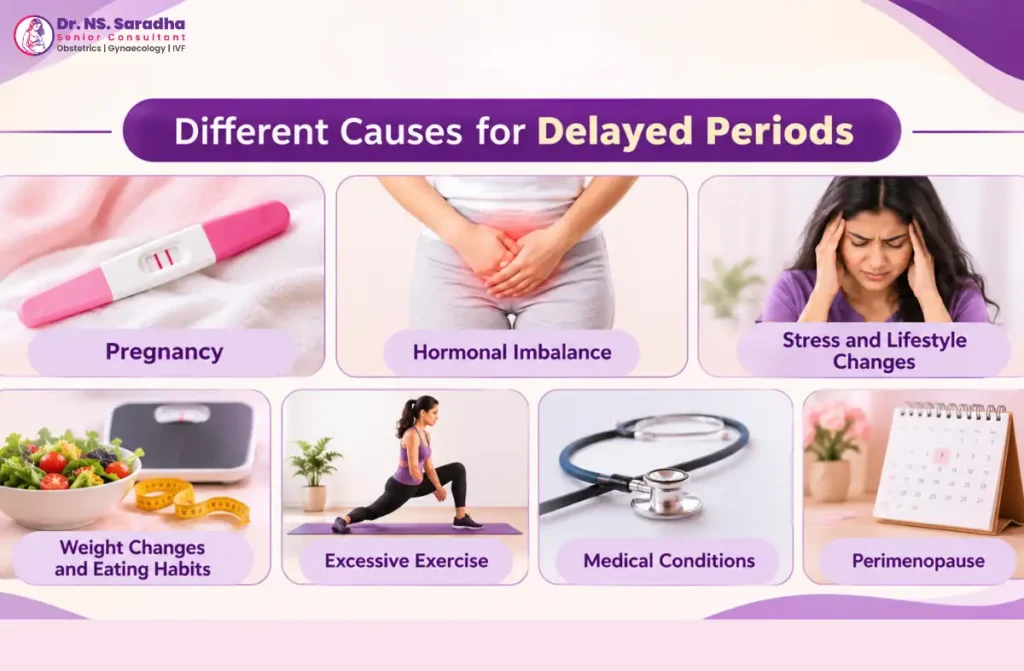
Causes of delayed periods fall into a few groups. Most of them affect ovulation, so the period comes later than expected.
Pregnancy
Pregnancy is the most common reason for a missed period in a woman with regular cycles who may have had unprotected sex. This is why a pregnancy test should always come first.
Polycystic Ovary Syndrome (PCOS)
In PCOS, hormone levels interfere with regular ovulation. Periods may come every two to three months or skip entirely. Other signs can include acne, extra hair growth and weight gain. You can read more about PCOS and hormonal disorders on our website.
Stress and Emotional Changes
Long periods of worry, grief or heavy workload can change the signals your brain sends to your ovaries. Ovulation may be delayed, and the period follows later.
Thyroid Problems
The thyroid gland controls the body’s energy and hormone balance. Both an underactive and an overactive thyroid can cause late, light or missed periods.
Sudden Weight Gain or Weight Loss
Your body needs enough energy to support ovulation. Rapid weight loss, crash dieting or a very low body weight can stop ovulation. Sudden weight gain can also upset hormone balance.
Excessive Exercise
Very intense training, especially with low food intake, can lower the hormones that control ovulation. This is common in athletes and in women who suddenly start heavy workouts.
Hormonal Imbalances
Other hormone changes, such as raised prolactin (the milk hormone) or low oestrogen, can also affect periods. A blood test helps find these.
Breastfeeding and Postpartum Changes
While breastfeeding, prolactin can keep ovulation switched off, so periods may stay away for several months after delivery. Cycles can also be irregular for a while once they return.
Perimenopause
Perimenopause is the transition before menopause, often starting in the 40s. Cycles may become shorter, longer or skip months. You can learn more about menopause and perimenopause care here.
How to Get Periods Immediately: Safe Ways to Support Your Menstrual Cycle
Many women also search for how to get periods immediately at home, but there is no scientifically proven instant method. What you can do is support your overall hormonal health. Finding the reason behind the delay matters far more than trying to force bleeding. Please remember that none of the habits below can guarantee a period on a certain day.
Manage Stress and Practise Relaxation
When you are under stress, your body releases hormones that can interrupt the signals needed for ovulation. Slow breathing, short meditation, listening to calming music or a quiet walk can lower stress levels. These steps help your cycle settle over time. They do not bring a period within hours.
Maintain a Balanced and Nutritious Diet
Regular meals with vegetables, fruits, whole grains, protein and healthy fats give your body the energy it needs for ovulation. Skipping meals or eating too little can delay periods. If you are looking for natural ways to get periods back on track, steady and balanced eating is one of the most useful starting points.
Include Gentle Exercise and Yoga
Walking, stretching and moderate yoga support circulation, mood and sleep. They are helpful for how to get periods naturally over the long term. Very hard or very long workouts have the opposite effect and can contribute to missed periods.
Maintain a Healthy Sleep Routine
Hormones follow a daily rhythm. Going to bed and waking up at similar times, and getting seven to eight hours of sleep, helps this rhythm stay steady. Poor sleep for weeks can add to hormonal imbalance.
Stay Hydrated
Drinking enough water supports general health, digestion and energy. There is no evidence that drinking extra water will trigger a period, so it is a healthy habit and not a remedy.
Use Warm Compresses for Comfort
A warm compress or hot water bag on the lower tummy can ease cramps and discomfort. It relaxes the muscles, but it does not make a period start.
Foods and Home Remedies to Get Periods Faster: Myths and Facts
Many families pass down beliefs about foods to get periods earlier. Some of these foods are healthy, and small amounts in a meal are usually fine. But no food or drink has been proven to start a period immediately. Here is what tradition says and what the evidence shows.
Does Papaya Help Bring Periods?
Traditionally, raw or unripe papaya is believed to bring on periods. There is no good clinical proof for this. Unripe papaya can be unsafe in early pregnancy, so it should not be used as a test or a remedy. Ripe papaya in normal amounts is simply a healthy fruit.
Can Pineapple Trigger Menstruation?
Pineapple contains an enzyme called bromelain, which is why people believe it affects periods. Studies have not shown that eating pineapple starts menstruation. A slice or a glass of juice is fine, but it will not change your cycle date.
Does Ginger Tea Help With Delayed Periods?
Ginger tea is a comforting drink and may ease cramps for some women. There is no reliable evidence that it starts a delayed period. Enjoy it in normal amounts and avoid very strong ginger preparations.
Can Turmeric Milk Regulate Periods?
Turmeric milk is a warm, traditional drink in many homes. Research has not proven that it regulates periods or brings them early. Used in cooking or a small cup of milk, it is safe for most people.
Does Vitamin C Help Start Periods?
Vitamin C is an important nutrient, and it is found in oranges, guavas, amla and lemon. However, there is no proof that it starts a period. Very high doses from supplements can cause stomach upset and should not be taken for this purpose.
Can Fenugreek Water Help With Menstrual Irregularities?
Fenugreek (methi) seeds are used in traditional home care. Research on its effect on periods is limited and does not show it can start one. Strong fenugreek preparations and supplements can affect blood sugar and are not advised in pregnancy.
Eating these foods as part of a normal meal is very different from taking concentrated herbal powders, strong mixtures or supplements. Please do not use strong herbal mixtures, high-dose vitamins or unverified remedies, especially if there is any chance you are pregnant.
Medical Ways to Manage Delayed Periods
When a delay keeps happening, or when treatment is needed for a good reason, a gynaecologist can help. The right option depends on the cause, your age, your health history and whether you plan to become pregnant.
Progesterone-Based Hormonal Treatment
In some women, a doctor may prescribe a short course of a progesterone-type medicine. When it is stopped, the uterus lining sheds and withdrawal bleeding follows. It is only used after pregnancy has been ruled out and after a doctor has decided it is suitable.
Birth Control Pills for Menstrual Cycle Regulation
Combined hormonal pills are often used for irregular periods treatment, because they create a steady monthly bleeding pattern. They are not suitable for everyone, so a doctor must check your health history first.
Treatment for PCOS and Thyroid Disorders
When PCOS or a thyroid problem is behind the delay, treating that condition is the real solution. This can include lifestyle changes, medicines to support ovulation or regular cycles, and thyroid medicines.
Medical Evaluation for Hormonal Imbalances
A gynaecologist starts with your history and a physical check. Depending on the findings, a urine pregnancy test, blood tests for thyroid, prolactin and other hormones, and an ultrasound scan may be advised. Treatment is then chosen to match the cause.
Period induction tablets should only be taken when prescribed. Buying hormonal tablets from a pharmacy or online without a prescription can be unsafe. They can mask the real problem, cause heavy bleeding and be risky if you are pregnant.
What Should You Do Before Trying to Get Your Period?
Before you try any remedy, make sure pregnancy is not the reason for the delay.
- Take a home pregnancy test if there is any chance you could be pregnant.
- Test from the first day of your missed period. Testing earlier can give a false negative, because the pregnancy hormone may not yet be high enough to show.
- Use the first urine of the morning, which is more concentrated.
- If the test is negative but your period still does not come, repeat the test after 3 to 7 days or see a doctor.
- Do not take hormonal medicines or herbal products without medical guidance.
Can You Prepone Your Periods for a Wedding, Trip or Special Event?
Many women want to know how to prepone periods before a wedding, a pooja or a holiday. If you are searching for how to get periods immediately before such an event, the safest answer is to plan ahead with your doctor.
Periods can sometimes be moved with doctor-supervised hormonal medicines. This needs a few weeks of planning, because the medicine has to be taken for a set time. Your doctor will first check that it suits you, as it may not be safe for women with certain health conditions, such as a history of blood clots. Home remedies cannot reliably change your period date, and last-minute tablets taken without advice can lead to side effects or irregular bleeding afterwards.
When Should You Consult a Gynaecologist for Delayed Periods?
An occasional late period is usually not serious. It is time to see a gynaecologist if you notice any of these:
- Your periods have been missing for three months in a row, and they were regular before.
- Your cycles are often shorter than 21 days or longer than 35 days.
- Bleeding is unusually heavy, or you pass large clots.
- You have ongoing pelvic pain or discomfort.
- You have signs of PCOS or a thyroid problem, such as acne, extra hair growth, weight changes or tiredness.
- You are under 15 and have not had a first period, or periods have not started within three years of breast development.
Please get urgent medical help if you have severe tummy pain, fainting, or heavy bleeding that soaks through a pad every hour. If you are pregnant or may be pregnant and feel severe abdominal pain, pain at the tip of the shoulder, dizziness or fainting, go to the hospital at once, as these can be signs of an ectopic pregnancy.
How Can You Maintain Regular Periods Naturally?
Good habits cannot guarantee perfect cycles, but they support your reproductive health and help with how to regulate menstrual cycles in the long term.
- Eat a balanced diet with enough calories, protein and iron-rich foods.
- Avoid crash dieting and very restrictive eating plans.
- Follow a regular sleep routine.
- Do moderate physical activity most days of the week.
- Find healthy ways to manage stress.
- Maintain a healthy weight for your height and age.
- Go for regular gynaecological check-ups, even when your periods seem normal.
Why Consult Dr. N.S. Saradha for Menstrual Health Concerns?
Dr. N.S. Saradha is a Senior Consultant in Obstetrics, Gynaecology and IVF with over 30 years of experience in women’s healthcare. Her care covers every stage of a woman’s life, from adolescence to motherhood and menopause, including menstrual and hormonal disorders, PCOS, ovulation problems and fertility care.
A delayed period has many possible causes, and the same advice does not suit everyone. A personal assessment looks at your cycle history, lifestyle, hormone health and any symptoms you have, so that treatment fits your needs instead of being a guess. If you are worried about how to get periods immediately, a consultation can tell you why your period is late and what to do next. You can read about menstrual disorders, hormonal conditions and adolescent gynaecology on our website, or learn more about Dr. N.S. Saradha.
You can meet Dr. Saradha at two locations:
- Agna Clinic, Saligramam: No. 48, 7 – Muthukumarappa Street, opposite Arcot Road, Chennai – 600093, 7:00 PM to 9:00 PM.
- SIMS Hospitals, Vadapalani: No. 1, Jawaharlal Nehru Road, Chennai – 600026 (next to Vadapalani Metro), 9:00 AM to 6:00 PM.
Conclusion
A late period is common, and in most cases there is a clear reason behind it. It could be pregnancy, stress, weight changes, PCOS, thyroid problems or a natural life stage like breastfeeding or perimenopause. There is no proven answer to how to get periods immediately, and any quick fix that promises a period within hours should be avoided.
The safest steps are to rule out pregnancy, look at your recent stress, food, sleep and exercise, and keep a record of your cycle dates. Healthy habits help over the long run, and doctor-supervised treatment is available when it is truly needed. If your periods stay late or irregular, please do not wait for months or try random remedies.