
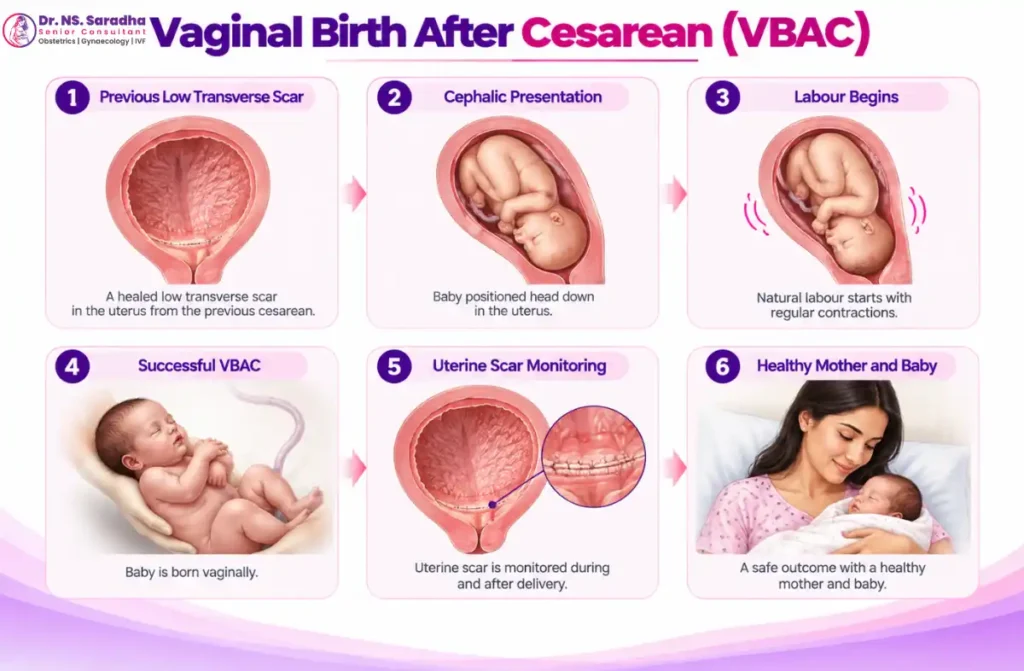
If you have had a cesarean before, you may be wondering if a vaginal delivery is possible this time. Many women can safely have a Vaginal Birth After Cesarean, and understanding how it works can help you talk to your doctor with confidence. This guide walks you through what VBAC means, who it suits, and what to expect at each stage.
What Is Vaginal Birth After Cesarean (VBAC)?
Vaginal Birth After Cesarean, or VBAC, is when a woman delivers her baby through the vagina after having a cesarean section in an earlier pregnancy. It is also called a trial of labor after cesarean, or TOLAC, before the delivery happens. Not every woman with a past cesarean needs another one, and many go on to have a normal vaginal delivery in later pregnancies. The choice depends on your medical history, the type of cesarean cut you had, and how your current pregnancy is progressing. Your doctor will review these details with you well before your due date.
VBAC vs. Repeat Cesarean Delivery
A repeat cesarean is a planned surgery done again in a later pregnancy, usually scheduled a week or so before the due date. VBAC, on the other hand, means labor is allowed to start and progress naturally, with surgery kept as a backup option. Recovery after VBAC is usually faster, and hospital stays tend to be shorter compared to surgery. Repeat cesarean can feel more predictable since the date is fixed, while VBAC involves waiting for labor to begin on its own. Both paths are medically accepted, and the right one depends on your body, your baby, and your doctor’s assessment.
How Common Is VBAC?
VBAC has become a well-recognized option in modern maternity care, and many hospitals now support it for suitable candidates. The number of women choosing to attempt VBAC has grown steadily as awareness and hospital readiness have improved. Success also depends heavily on access to a hospital with round-the-clock surgical backup, since that safety net makes trial of labor possible. In India, more urban hospitals are now equipped to offer VBAC as awareness among expecting mothers increases. Talking to your doctor early in pregnancy gives you the clearest picture of how common and suitable VBAC would be in your specific case.
Why Do Some Women Choose VBAC?
Many women choose VBAC because they want to avoid another major abdominal surgery and its longer recovery period. Others prefer the experience of labor and vaginal delivery, including holding and feeding their baby sooner after birth. Some women also plan to have more children and want to reduce the risks that come with multiple cesarean surgeries over time. A shorter hospital stay and quicker return to daily activities are practical reasons many mothers bring up. Ultimately, the decision is personal, and your doctor’s role is to help you weigh these reasons against your individual health picture.
Is VBAC Safe?
VBAC is considered a safe option for most women who meet the medical criteria, especially when delivery happens in a hospital equipped for emergency surgery. Doctors monitor labor closely so that any warning signs can be caught early and managed quickly. Safety depends on factors like the type of previous cesarean cut, the reason for that surgery, and your current pregnancy health. While no delivery method is completely free of risk, studies consistently show that a well-monitored VBAC carries a low chance of serious complications for suitable candidates. Your doctor will only recommend attempting VBAC after reviewing your full obstetric history.
Benefits of VBAC
Choosing a successful VBAC can mean a shorter hospital stay, often just one or two days compared to three or four after surgery. Recovery is generally quicker, with less pain and an easier return to normal movement and daily routines. There is no surgical incision to heal, which lowers the risk of wound infection or scar-related discomfort. Blood loss during a vaginal delivery is typically less than during a cesarean, which can support faster overall recovery. Many mothers also value the ability to bond with and breastfeed their baby soon after birth without the effects of surgical anesthesia to work through.
Risks of VBAC
The most serious risk during a VBAC attempt is uterine rupture, though this remains uncommon among carefully selected candidates. If labor does not progress well, an emergency cesarean may still be needed partway through the process. This is why VBAC should only be attempted in a hospital where an operating room and surgical team are ready at short notice. Other risks are similar to those of any vaginal delivery, such as tearing or the need for assisted delivery tools. Your doctor will explain these risks clearly and help you understand how they apply to your specific situation.
What Is Uterine Rupture?
Uterine rupture is a tear that can occur along the scar line from a previous cesarean during labor contractions. It is a rare but serious event, which is why VBAC labor is closely monitored from start to finish. Warning signs can include sudden abdominal pain, changes in the baby’s heart rate, or slowing labor progress, and hospital staff are trained to watch for these. When it does happen, quick surgical response usually leads to a good outcome for both mother and baby. This is the main reason doctors recommend VBAC only in hospitals with immediate access to an operating theatre.
When Is VBAC Considered Unsafe?
VBAC is generally not recommended if you have had a classical, or vertical, uterine incision in a previous cesarean, since this type carries a higher rupture risk. It may also not be suitable if you have had more than two previous cesareans, certain uterine surgeries, or specific pregnancy complications this time around. Placenta previa, where the placenta covers the birth canal, is another situation where a repeat cesarean is usually the safer path. If your baby is in a difficult position or is significantly larger than average, your doctor may advise against attempting labor. Every case is reviewed individually, so a conversation with your obstetrician is the best way to know where you stand.
Who Is a Good Candidate for VBAC?
Good candidates for VBAC typically have one previous low-transverse cesarean cut, no other major uterine surgery, and a current pregnancy without complications. Your doctor looks at several specific pieces of your history together, not just one factor alone, to decide if attempting labor is reasonable.
Previous Cesarean Delivery Type
The type of incision made in the uterus during your earlier cesarean matters more than the skin incision you can see. A low-transverse, or horizontal, cut across the lower uterus carries the lowest risk and is the most common type used today. A classical, or vertical, cut is linked to a higher chance of rupture and usually rules VBAC out. If you are unsure which type you had, your previous hospital’s operation notes can confirm this detail for your doctor.
Number of Previous C-Sections
Women who have had one previous cesarean generally have the best chances of a safe and successful VBAC. Having had two cesareans does not automatically rule out VBAC, but it does call for a more careful case-by-case review. Three or more previous cesareans usually make a repeat surgery the recommended and safer choice. Your doctor will look at how each of those earlier surgeries healed before advising you either way.
Reason for the Previous Cesarean
If your earlier cesarean was done for a reason specific to that pregnancy, such as the baby being in a breech position, VBAC is often a reasonable option this time. If the reason was related to your pelvis or body structure, such as a labor that could not progress despite strong contractions, your chances of a successful VBAC may be lower. Understanding the original reason helps your doctor judge whether the same issue is likely to repeat. This is one of the first questions your doctor will ask when discussing VBAC with you.
Previous Vaginal Birth
If you have delivered vaginally before your cesarean, or in between cesareans, this history works in your favor for a VBAC attempt. It shows your body has been able to progress through labor and deliver vaginally at least once. Doctors often see this as one of the stronger positive signs when reviewing VBAC candidacy. Even a vaginal birth from many years ago is still useful information for your current assessment.
Time Between Pregnancies
Waiting at least eighteen months between your cesarean and your next delivery gives the uterine scar more time to heal fully. A shorter gap between pregnancies has been linked to a slightly higher risk of complications during a VBAC attempt. This does not mean VBAC is impossible with a shorter gap, but your doctor will factor this timing into the overall risk picture. Spacing pregnancies with your doctor’s guidance is a simple step that can support a smoother VBAC later.
Overall Pregnancy and Maternal Health
Conditions such as high blood pressure, gestational diabetes, or a low-lying placenta can all affect whether VBAC is advisable this time. Your general health, including your weight and any ongoing medical conditions, is part of the full picture your doctor considers. A pregnancy without major complications generally supports a smoother path toward attempting VBAC. Regular prenatal visits help your doctor track these factors as your pregnancy progresses toward delivery.
Factors That Affect VBAC Success
Several personal and pregnancy-related factors influence how likely a VBAC attempt is to end in a vaginal delivery. Knowing these ahead of time helps set realistic expectations for your birth experience.
Previous Vaginal Delivery
A history of at least one vaginal birth, whether before or after a cesarean, is one of the strongest predictors of VBAC success. It suggests your pelvis and body have already shown they can support labor to a vaginal delivery. Doctors often note this specifically when calculating your individual chances. Even one prior vaginal birth can meaningfully improve the outlook for this pregnancy.
Previous Successful VBAC
If you have already had a successful VBAC in an earlier pregnancy, your chances of success this time are generally even higher. Each successful vaginal delivery after a cesarean adds to the evidence that your body can manage labor safely. This history is one of the most reassuring factors your doctor will look at. It also often means your doctor will feel comfortable supporting a similar plan again.
Baby’s Size and Position
A baby in the head-down position, with an estimated weight that fits your pelvis comfortably, supports a smoother VBAC attempt. If your baby is estimated to be much larger than average, or is positioned breech close to your due date, this can lower the chances of a vaginal delivery. Doctors use ultrasound scans in the final weeks to check position and estimated weight. These findings are discussed with you as part of your ongoing birth planning conversations.
Maternal Age and BMI
Younger mothers and those with a body mass index in the healthy range tend to have somewhat higher VBAC success rates. Age and weight are only two of many factors, so neither one alone rules VBAC in or out. Managing weight gain within the range your doctor recommends during pregnancy can support your chances. Your doctor will look at your full health profile rather than any single number in isolation.
Labor Starting Naturally
VBAC attempts where labor begins on its own tend to have better outcomes than those where labor is started artificially. Spontaneous labor allows the body to progress at its own pace, which is generally gentler on a previously scarred uterus. This is one reason doctors are often cautious about inducing labor in a VBAC pregnancy. If your pregnancy reaches term without labor starting, your doctor will discuss the safest next steps with you.
Gestational Age
Attempting VBAC at full term, generally after thirty-nine weeks, is associated with better outcomes than earlier attempts. Going significantly past your due date can change the risk balance and may lead your doctor to discuss induction or a planned cesarean. Your doctor will track your pregnancy week by week to time this decision appropriately. Regular check-ins in the final weeks help make sure this timing works in your favor.
VBAC Success Rate
Understanding the numbers behind VBAC can help you set realistic expectations for your own birth plan.
Average VBAC Success Rate
On average, about seven out of ten women who attempt a Vaginal Birth After Cesarean go on to deliver vaginally. This rate can shift higher or lower depending on your personal history and the specific factors your doctor reviews. It is an average across many women, so your own chances could be higher if you have favorable factors like a previous vaginal birth. Your doctor can give you a more personalized estimate once your full history and current pregnancy details are reviewed.
Factors That Increase VBAC Success
- A previous vaginal delivery, either before or after a cesarean
- Labor that starts naturally without induction
- A single previous low-transverse cesarean incision
- A healthy pre-pregnancy weight and good overall health
- Reaching the hospital in early labor rather than very late
Factors That May Reduce VBAC Success
- A previous cesarean done because labor did not progress
- A baby estimated to be significantly larger than average
- A pregnancy that goes well past the due date
- A shorter gap since the last cesarean delivery
- Certain maternal health conditions present in this pregnancy
How Doctors Estimate VBAC Probability
Doctors often use a combination of your medical history, current pregnancy findings, and clinical judgment to estimate your personal chance of success. Some use structured scoring tools that weigh factors like age, BMI, and prior vaginal delivery together. This estimate is not a fixed prediction but a helpful guide for planning your delivery approach. It also helps you and your doctor agree on realistic expectations before labor begins.
How to Prepare for a VBAC
Preparation makes a real difference in how smoothly your VBAC journey goes, from the first conversation with your doctor to the day of delivery.
Discuss Your Birth History With Your Doctor
Share every detail you remember about your previous delivery, including how labor progressed and why the cesarean was ultimately needed. This conversation helps your doctor understand whether the same issue is likely to come up again this time. Bring along any questions or concerns you have about attempting a vaginal delivery. Starting this discussion early in pregnancy gives you both time to build a clear plan together.
Review Your Previous Cesarean Records
Your previous hospital’s operative notes contain the exact type of uterine incision used, which is central to deciding on VBAC. If you delivered at a different hospital, try to obtain these records well before your due date. This single document can save time and give your doctor the clarity needed to guide your decision. Keeping a personal folder of your pregnancy and delivery records is a good habit for future pregnancies too.
Choose a Hospital Equipped for VBAC
A VBAC attempt should only take place at a hospital with round-the-clock access to an operating theatre, anesthesia team, and blood bank support. This ensures that if an emergency cesarean becomes necessary, it can happen without delay. Dr. N.S. Saradha’s practice is set up with this kind of continuous surgical readiness, and the clinic’s Saligramam location in Chennai is easy to reach for mothers across the city. Ask about a hospital’s VBAC support and emergency response time as part of your birth planning. Choosing the right hospital early removes one of the biggest sources of last-minute stress.
Create a Flexible Birth Plan
A birth plan for VBAC should outline your preferences while staying open to changes based on how labor unfolds. Talk with your doctor about pain relief choices, monitoring preferences, and what would happen if a cesarean becomes necessary. Writing this down and reviewing it together helps everyone involved understand your wishes in advance. Flexibility is important because labor does not always follow an exact script, even with the best preparation.
Understand When a Repeat C-Section May Be Needed
Knowing in advance what signs would lead to a switch to cesarean can make that decision feel less sudden if it happens. Common reasons include labor that stalls for a long period, signs of fetal distress, or concerns about the uterine scar. Understanding this ahead of time helps you feel prepared rather than caught off guard. Your doctor will always explain what is happening and why before any change in plan.
What Happens During a VBAC?
Knowing what to expect during labor can help you feel calmer and more in control on the day itself.
Monitoring During Labor
Continuous fetal heart rate monitoring is standard practice during a VBAC attempt to catch any early signs of trouble. Your contractions are also tracked closely to see how labor is progressing over time. This close monitoring is one of the key safety measures that makes VBAC possible in a hospital setting. Your care team will keep you informed throughout so you understand what the readings mean.
Pain Relief Options
Epidurals are commonly used and considered safe during a VBAC labor, and they do not hide the signs doctors watch for during rupture risk. Other options include breathing techniques, position changes, and short-acting pain medications depending on your stage of labor. Discussing pain relief preferences with your doctor beforehand helps you feel ready for the options available. Your comfort during labor is an important part of your overall birth experience.
Induction and Augmentation of Labor
Inducing labor in a VBAC pregnancy is approached carefully, since certain induction methods carry a higher rupture risk than others. Augmentation, which means helping labor along once it has already started naturally, is generally considered safer than starting labor artificially from the beginning. Your doctor will weigh the reasons for induction against these added risks before recommending it. Any decision here is made with your full understanding of the trade-offs involved.
When an Emergency Cesarean May Be Required
If fetal heart rate patterns show signs of distress, or if labor stops progressing despite strong contractions, a switch to cesarean may be recommended. Sudden abdominal pain that does not match a normal contraction pattern is another sign the care team watches for closely. Because the operating team is on standby throughout a VBAC attempt, this switch can typically happen within minutes. Being prepared for this possibility in advance, as part of your birth plan, makes the moment easier to handle if it arises.
VBAC After Multiple Cesareans
If you have had more than one previous cesarean, VBAC is still worth discussing, though it needs a more detailed review.
Is VBAC Possible After Two C-Sections?
Yes, VBAC after two previous cesareans is possible for some women, though success rates are somewhat lower than after just one. Doctors look closely at how both previous surgeries were performed and how your body recovered afterward. This path requires careful hospital selection and close monitoring throughout labor. Your doctor will walk you through the specific numbers that apply to your case.
What Are the Additional Risks?
Uterine rupture risk rises somewhat with each additional previous cesarean, making close monitoring even more important. Scar tissue from multiple surgeries can also affect how labor progresses and how the uterus responds to contractions. These are not reasons to rule VBAC out automatically, but they do shape a more cautious approach. Your doctor will discuss these specific risks in the context of your full medical history.
How Doctors Assess Eligibility
Doctors review the type of incision used in both previous surgeries, the reasons behind them, and how your recoveries went. Current pregnancy health, baby’s size and position, and the gap between pregnancies all factor into this review as well. This is typically a more detailed conversation than a first-time VBAC discussion. Bringing complete records from both previous deliveries helps this assessment move smoothly.
VBAC After a Classical C-Section
The type of cut made during your earlier surgery plays a major role in whether VBAC can be considered at all.
Why the Type of Uterine Incision Matters
A classical incision runs vertically along the upper, stronger part of the uterus, which experiences more stretching force during labor. This type of scar carries a meaningfully higher risk of rupture compared to the more common low-transverse cut. Because of this, the incision type is one of the very first things your doctor checks in your records. It is a structural detail, not a reflection of anything you did during your previous delivery.
When VBAC Is Generally Not Recommended
If your previous surgery used a classical or T-shaped incision, doctors generally recommend a planned repeat cesarean rather than attempting labor. This same guidance applies to women who have had significant uterine surgery unrelated to a cesarean, such as certain fibroid removals. In these situations, a planned cesarean offers a safer and more predictable path to delivery. Your doctor will explain this recommendation clearly and answer any questions you have about it.
VBAC and Labor Induction
Induction is one of the more nuanced topics in VBAC planning, since it changes the risk profile compared to labor starting on its own.
Can Labor Be Induced After a C-Section?
Yes, induction is sometimes considered for VBAC pregnancies, though it is approached with more caution than in a first delivery. Your doctor will weigh the medical reason for induction against the slightly higher risks it can carry for a scarred uterus. This decision is always individualized rather than routine. A clear conversation about the specific reason for induction helps you understand the choice being made.
Which Induction Methods May Be Considered?
Mechanical methods, such as a balloon catheter to gently open the cervix, are often preferred over certain medications in VBAC pregnancies. Oxytocin, given carefully and in controlled doses, may also be used to help labor along once conditions are right. Some medications used for induction in first pregnancies are generally avoided in VBAC due to a higher rupture risk. Your doctor will select the method that best fits your specific situation and monitor you closely throughout.
Why Induction Can Affect VBAC Risks
Induced contractions can sometimes be stronger or more sudden than those that start naturally, which places more stress on the uterine scar. This is why certain induction drugs are avoided and why close monitoring becomes even more important if induction is used. It does not mean induction is unsafe, but it does mean the approach is more measured. Your care team’s job is to balance the benefits of induction against these added considerations for your specific case.
Benefits of a Successful VBAC
A vaginal delivery after a previous cesarean can offer several practical advantages during recovery and beyond.
Avoiding Major Abdominal Surgery
Skipping another surgery means avoiding the risks that come with repeat abdominal operations, such as scar tissue buildup and longer anesthesia exposure. Each additional cesarean can make future surgeries technically more complex due to internal scarring. A successful VBAC keeps this surgical history from adding up. This is one of the more significant long-term benefits many women consider when weighing their options.
Shorter Recovery Time
Most women recover from a vaginal delivery within days, compared to several weeks of restricted activity after a cesarean. There is no abdominal incision to protect, so movement, walking, and even climbing stairs come back sooner. This quicker recovery can make caring for a newborn, and any older children at home, noticeably easier. Many mothers describe this as one of the most appreciated benefits of a successful VBAC.
Lower Risk of Surgical Complications
A vaginal delivery avoids surgical risks such as wound infection, internal scarring, or reactions to anesthesia used during a cesarean. Blood loss is also typically lower with a vaginal birth than with abdominal surgery. These lower risks are part of why doctors support VBAC for women who are good candidates. Discussing your personal risk profile with your doctor gives you a clear picture of how much this benefit applies to you.
Potential Benefits for Future Pregnancies
Every additional cesarean increases certain risks in future pregnancies, including placenta-related complications and surgical scar issues. A successful VBAC can reduce your total number of cesarean deliveries over your reproductive years. This can matter a great deal if you are planning to have more children after this pregnancy. Your doctor can walk you through how this benefit applies to your specific family planning goals.
Risks and Possible Complications of VBAC
Understanding the possible complications of VBAC helps you make an informed choice alongside your doctor.
Uterine Rupture
Uterine rupture remains the most serious complication associated with VBAC, though it occurs in a small percentage of attempts among well-selected candidates. Hospitals prepared for VBAC monitor for warning signs throughout labor so that response can be immediate if needed. This is the central reason hospital choice and continuous monitoring matter so much for VBAC safety. Your doctor will discuss your individual rupture risk based on your specific surgical history.
Failed Trial of Labor
Sometimes, despite every preparation, labor does not progress as hoped and a cesarean becomes necessary partway through. This is not a failure on your part, but simply how that particular labor unfolded. Around three in ten VBAC attempts end this way, based on overall averages. Your care team’s priority throughout is the safe delivery of your baby, whichever path that ultimately takes.
Emergency Cesarean Delivery
An emergency cesarean during a VBAC attempt is performed quickly because the surgical team is already on standby throughout labor. Reasons can include fetal distress, stalled labor, or signs pointing toward possible uterine rupture. Recovery from an emergency cesarean is similar to a planned one, though it can feel more sudden emotionally. Talking through this possibility with your doctor in advance can help you feel more prepared if it happens.
Maternal and Baby-Related Risks
Beyond rupture, VBAC carries similar general risks to any vaginal delivery, such as perineal tearing or the need for assisted delivery with forceps or vacuum. For the baby, risks are generally comparable to those of a standard vaginal birth when VBAC candidacy has been properly assessed. Continuous monitoring throughout labor is designed to catch and manage these situations early. Your doctor will personalize this risk discussion based on your pregnancy and delivery history.
VBAC vs. Repeat C-Section
Comparing these two paths side by side can help you and your doctor decide which one fits your situation best.
Recovery and Hospital Stay
VBAC recovery is typically quicker, often allowing discharge within one to two days if there are no complications. A repeat cesarean generally means a hospital stay of three to four days, plus a longer period of restricted activity at home. This difference matters especially if you have other children needing your attention soon after delivery. Your doctor can give you a realistic recovery timeline based on which path you choose.
Risks and Benefits
VBAC offers a faster recovery and avoids another surgery but carries a small risk of uterine rupture and a chance that labor may still end in cesarean. A repeat cesarean is more predictable and avoids labor-related risks but comes with standard surgical risks and a longer recovery. Neither option is without trade-offs, which is why this decision is made together with your doctor. Weighing what matters most to you personally is part of this conversation.
Impact on Future Pregnancies
A successful VBAC can lower the total number of cesareans in your future, which reduces certain long-term surgical risks. Repeated cesareans, on the other hand, gradually increase the chance of complications like placenta previa or accreta in later pregnancies. If you are planning a larger family, this long-term view is worth discussing early. Your doctor can help you think through how each option affects your future pregnancy plans.
How to Decide Between VBAC and Repeat C-Section
Start by reviewing your previous delivery records with your doctor, including the type of incision and the reason for that surgery. Consider your current pregnancy health, your baby’s size and position, and how many children you hope to have in the future. Think about what matters most to you personally, whether that is a predictable delivery date or a faster recovery. This decision works best as an ongoing conversation with your doctor rather than a single appointment choice.
Conclusion
Deciding between a Vaginal Birth After Cesarean and a repeat cesarean is a personal choice that depends on your medical history, your current pregnancy, and what feels right for you. Both paths can lead to a safe and healthy delivery when guided by careful monitoring and an experienced medical team. The most important step is an open conversation with your doctor, who can review your specific history and help you understand your realistic options. With the right preparation and hospital support, many women go on to have a safe and positive VBAC experience.