Starting a family is one of the most personal journeys in life. When that journey feels difficult, the right medical support can make a real difference. Dr. N.S. Saradha is a dedicated fertility doctor in Chennai with years of focused experience in reproductive medicine. She helps couples and individuals understand what is happening with their fertility and guides them through every step of treatment from the first consultation to the final outcome.
Dr. N.S. Saradha believes that fertility care should feel personal, not clinical. Her approach is built around honest conversations, clear explanations, and treatment plans that match each patient’s unique situation. Whether you are just starting to explore your options or have already been trying for some time, you will find a calm and supportive environment at her clinic.
Her clinic is easily accessible as a fertility doctor in Vadapalani and a fertility doctor in Saligramam, making quality reproductive care available to patients across West Chennai and beyond.
The very first thing Dr. N.S. Saradha does before recommending any treatment is a thorough fertility assessment. This is not a formality. It is the most important step in the entire process. Without knowing exactly what is happening — biologically, hormonally, structurally — any treatment is just guesswork. And guesswork wastes your time, your money, and your emotional energy.
A fertility assessment is a comprehensive evaluation of both partners. This is important to emphasise, because fertility is never just a "woman's issue." Research consistently shows that male factors contribute to about 40 to 50 percent of all cases of infertility. Evaluating both partners from the start gives a far more complete and accurate picture.
For women, the assessment typically includes:
For men, the assessment includes:
After all the results are in, Dr. N.S. Saradha — a specialist in Fertility & Reproductive Medicine in Chennai — sits with you and explains every finding in plain language — not medical jargon, not numbers without context. She tells you what the results mean, what may be causing the issue, and what treatment options make the most sense given your specific situation. This conversation is where the real journey begins.
Ovulation is the release of a mature egg from the ovary each month. For conception to happen naturally, this process needs to occur regularly and at the right time. But for many women, ovulation is irregular, unpredictable, or absent altogether. This is far more common than most people realise and is one of the leading causes of difficulty conceiving.
Conditions like Polycystic Ovary Syndrome (PCOS), thyroid disorders, high prolactin levels, or significant weight changes can all interfere with ovulation. Some women have regular periods but still do not ovulate every cycle — something that cannot be detected without proper monitoring.
Ovulation induction is a treatment that uses medication to stimulate the ovaries to develop and release one or more mature eggs. As a fertility doctor in Vadapalani, Dr. N.S. Saradha uses this as a first-line treatment for appropriate patients because it is effective, affordable, and gentle on the body.
How the process works:
The treatment begins on day 2 or 3 of the menstrual cycle. Oral tablets — most commonly Letrozole or Clomiphene Citrate — are taken for 5 days to encourage the ovaries to develop follicles. Each follicle contains one egg. As the cycle progresses, serial ultrasound scans (called follicular monitoring) are done every few days to track how the follicles are growing.
Once the leading follicle reaches the ideal size — usually between 18 and 20 mm — a trigger injection (HCG or a GnRH agonist) is given to finalise egg maturation and time the exact moment of ovulation. The couple is then guided on the best window for timed intercourse or prepared for IUI if that is part of the plan.
In some cases, especially for women with PCOS who do not respond to oral medications, low-dose injectable gonadotropins are added to strengthen the response. This is done carefully and monitored closely to avoid overstimulation.
Why monitoring matters:
One of the most important parts of ovulation induction is the ultrasound monitoring. Without it, you cannot know if follicles are actually growing, how many are developing, or whether ovulation actually happened. Dr. N.S. Saradha's clinic follows a structured monitoring schedule to ensure safety and to time the treatment accurately — because even a few hours can make a difference.
Ovulation induction is often the first step in a Fertility & Reproductive Medicine journey. For many women, it is all that is needed. It gives the body a well-timed, medically supported opportunity to conceive naturally, and with minimal intervention.
Intrauterine insemination, commonly known as IUI, is a procedure that bridges the gap between natural conception and more advanced treatments like IVF. It is simple, non surgical, and takes only a few minutes to perform but when done at the right time and for the right patient, it can be remarkably effective.
The procedure involves processing and preparing a semen sample in the laboratory to concentrate the healthiest, most active sperm. This prepared sample is then placed directly into the uterus using a thin, flexible catheter bypassing the cervix and reducing the distance sperm need to travel to reach the egg.
As a fertility doctor in Saligramam, Dr. N.S. Saradha performs IUI with careful attention to timing, preparation quality, and patient comfort.
Who is IUI suitable for?
What happens during an IUI cycle?
The cycle begins similarly to ovulation induction. Medications are used to stimulate one or two follicles to mature. Monitoring scans ensure follicle development is on track. When the leading follicle is ready, the trigger injection is given and the IUI is scheduled 36 hours later right when ovulation is expected.
On the day of the procedure, the male partner provides a semen sample, which is processed in the laboratory over 30 to 60 minutes. The washed sperm sample is then drawn into a thin catheter and gently introduced into the uterine cavity. Most women describe the procedure as mild discomfort, similar to a routine pap smear. There is no need for anaesthesia, no recovery time, and no disruption to daily life.
A pregnancy test is done approximately 14 days after the procedure.
How many IUI cycles are typically advised?
Most specialists recommend trying IUI for 3 to 4 cycles before reviewing progress. If pregnancy has not occurred by then, it is usually a signal to move toward IVF or investigate further. Dr. N.S. Saradha reviews each cycle individually looking at what worked, what can be adjusted, and whether continuing with IUI remains the right approach.
IUI is not suitable for everyone. Women with blocked fallopian tubes, significantly low ovarian reserve, or severe male factor infertility generally benefit more from moving directly to IVF or ICSI. The fertility assessment helps identify which path is right from the start.
In vitro fertilisation IVF is one of the most significant medical developments of the last 50 years. For millions of people around the world, it has made parenthood possible when all other options had been exhausted. Today, IVF is not a last resort. It is a well-established, highly refined treatment that is recommended at the right stage of the fertility journey for the right patients.
Dr. N.S. Saradha is an experienced IVF doctor in Chennai who has guided patients through this process with clinical precision and genuine compassion. She understands that IVF is not just a medical procedure it is an emotional commitment, and patients deserve a doctor who acknowledges both sides of that.
What is IVF and how does it work?
IVF works by retrieving mature eggs from the ovaries, fertilising them with sperm in a controlled laboratory environment, monitoring the development of the resulting embryos, and transferring one or two of the best embryos into the uterus. The process happens over the course of a single menstrual cycle and involves several distinct stages.
Stage 1 – Ovarian stimulation (approximately 10 to 14 days)
Hormone injections are given daily to stimulate the ovaries to produce multiple mature follicles. The goal is to collect several eggs in one cycle, which gives more embryos to work with and improves the overall chances of success. Throughout this phase, regular ultrasound scans and blood tests monitor how the follicles are responding and allow the medication dose to be adjusted if needed.
Stage 2 – Trigger injection and egg retrieval
Once the follicles reach the optimal size, a trigger injection is given to complete egg maturation. Egg retrieval is scheduled 36 hours later. The procedure is done under light sedation so the patient is comfortable and pain-free. Using a fine needle guided by ultrasound, the eggs are gently aspirated from each follicle. The entire procedure takes about 20 to 30 minutes. Most patients rest for a few hours and go home the same day.
Stage 3 – Fertilisation in the laboratory
The retrieved eggs are handed to the embryology team, who assess their maturity and combine them with the prepared sperm sample. Fertilisation is checked the following day. Successfully fertilised eggs are called embryos.
Stage 4 – Embryo culture and development
The embryos are kept in a controlled incubator and monitored closely over 3 to 5 days. The embryologist assesses their development at each stage looking at cell division, symmetry, and quality. The best-quality embryos are selected for transfer. Remaining good-quality embryos can be frozen for future use.
Stage 5 – Embryo transfer
The transfer is a straightforward procedure, similar to an IUI. A thin catheter is used to place one or two embryos into the uterine cavity, guided by ultrasound for precision. No anaesthesia is needed. Patients are advised to rest for a short period afterward and then resume normal, gentle activity.
Stage 6 – Luteal support and the two-week wait
Progesterone medications are given after the transfer to support the uterine lining and help the embryo implant. A blood test to check for pregnancy is done 14 days after the transfer.
Who is IVF recommended for?
Dr. N.S. Saradha reviews each case individually. IVF is recommended when the evidence supports it not as a default, and not without a thorough conversation with the patient first.
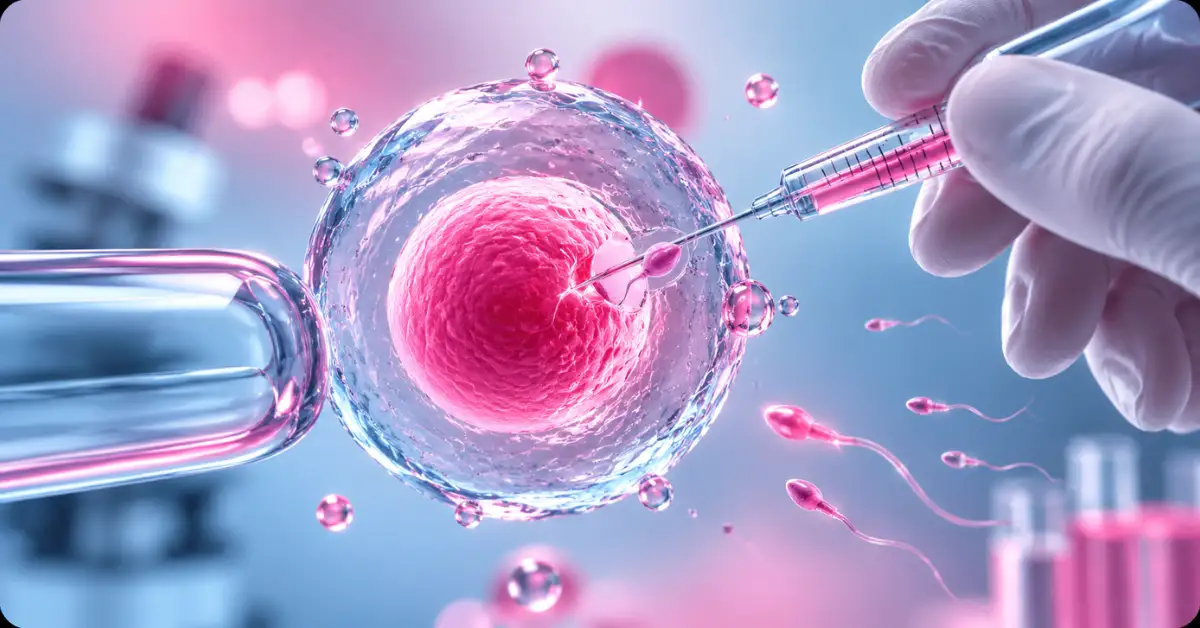
ICSI is a specialised technique used within the IVF process. While standard IVF involves mixing eggs and sperm together and allowing fertilisation to occur naturally in the lab dish, ICSI goes one step further. A single sperm — selected individually for its quality — is injected directly into the centre of the egg using a microscopic needle.
This technique was developed specifically to address cases where sperm cannot fertilise the egg on their own. It has been transformative for couples dealing with significant male factor infertility and has helped many who were previously told that biological parenthood was not possible.
When is ICSI recommended?
How is ICSI performed?
The egg retrieval and all other stages of the IVF process remain the same. The difference happens in the laboratory. The embryologist examines the prepared sperm sample under a powerful microscope and selects the single best sperm — one that is well-shaped and motile. This sperm is immobilised and drawn into a very fine glass needle. The mature egg is held steady and the needle is carefully introduced through the outer layer of the egg to deposit the sperm directly into the cytoplasm.
Fertilisation is confirmed the next morning. From this point, the embryo development, culture, grading, and transfer process proceeds exactly as in standard IVF.
As a specialist in Fertility & Reproductive Medicine in Chennai, Dr. N.S. Saradha uses ICSI selectively for cases where the embryology evidence genuinely supports it. It is not offered as a routine add-on to every IVF cycle, because good clinical practice means using the right tool for the right situation.
ICSI has given many couples a real chance when sperm quality alone would have stood in the way. Combined with thorough male factor evaluation and a properly timed IVF cycle, it is a powerful and well-established solution.
Egg freezing — medically known as oocyte cryopreservation — is the process of collecting, freezing, and storing a woman's eggs so they can be used at a later point in time. It is not a new technology, but advances in freezing techniques over the past decade have made it significantly more reliable and effective than it used to be.
The technique now used is called vitrification — a process of ultra-rapid freezing that prevents ice crystals from forming inside the egg cells. Ice crystals can damage the delicate internal structure of an egg, which was the main limitation of older slow-freezing methods. With vitrification, survival rates of frozen eggs after thawing are now very high, and pregnancy rates from frozen eggs have become comparable to those from fresh eggs in many situations.
Who should consider egg freezing?
Egg freezing is not only for women who want to delay motherhood for personal or career reasons, although that is certainly a valid and increasingly common reason. There are several important medical situations where egg freezing is a proactive and protective step:
What does the process involve?
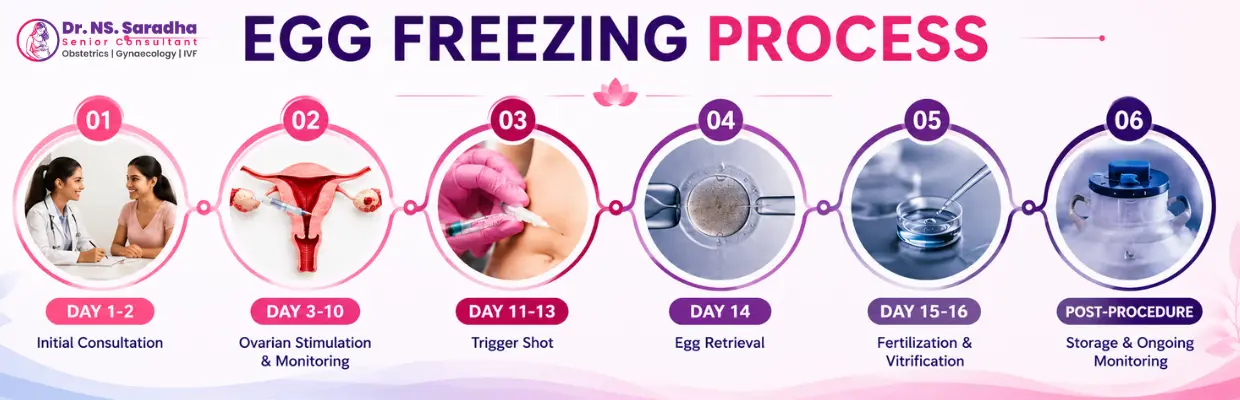
The egg freezing process begins in the same way as an IVF cycle. Hormone injections are given over 10 to 14 days to stimulate the ovaries to produce multiple mature follicles. The progress is monitored through ultrasound scans and blood tests. When the follicles reach the right size, a trigger injection is given and egg retrieval is performed under sedation — the same as in IVF.
The retrieved mature eggs are then immediately vitrified in the laboratory and stored at -196°C in liquid nitrogen tanks. They can remain safely stored for several years without significant deterioration in quality.
When the patient is ready to use her eggs, they are thawed, fertilised using ICSI (because the outer shell of the egg becomes slightly harder after freezing, making direct injection necessary), and the resulting embryos are transferred into the uterus.
An honest conversation before the decision
Dr. N.S. Saradha approaches egg freezing consultations with honesty. She discusses the patient's current ovarian reserve, how many eggs can realistically be expected from a single cycle, whether one cycle is likely to be sufficient, and what the real statistical chances of success are depending on age and reserve. This is important because egg freezing is not a guarantee — it is a preservation of possibility. Patients who understand this clearly are better placed to make informed decisions.
As a leading name in Fertility & Reproductive Medicine in Chennai, she sees patients from a wide range of backgrounds and life situations across Saligramam and Vadapalani. Her job is not to make the decision for them but to make sure they have everything they need to make the decision themselves.
A fertility journey is deeply personal. It asks a great deal of you emotionally, physically, and sometimes financially. What makes a difference in that journey is not just the quality of the treatment, but the quality of the relationship you have with your doctor. You need someone who tells you the truth, who explains what is happening in language you can understand, and who genuinely invests in your outcome.
Dr. N.S. Saradha is a committed IVF doctor in Chennai who brings both clinical depth and human care to every patient she sees. From the first consultation through every stage of treatment, her focus is on giving you the clearest possible picture of your situation and the most appropriate, evidence-based options available to you.
Her clinic serves patients across Chennai as a trusted fertility doctor in Vadapalani and fertility doctor in Saligramam with an environment that feels calm, a team that treats you with respect, and a doctor who is fully present at every step.
If you have been trying to conceive and are not sure what to do next or if you simply want to understand where your fertility stands right now a consultation with Dr. N.S. Saradha is the right place to start. One conversation can answer the questions that have been weighing on you and open the door to the next step forward.
You should consider seeing a fertility specialist if you have been trying to conceive for 12 months without success, or 6 months if you are over 35 years of age.
Fertility treatments include ovulation induction, intrauterine insemination (IUI), in vitro fertilisation (IVF), egg freezing, and surgical interventions to address structural causes of infertility.
Yes, maintaining a healthy weight, reducing alcohol intake, stopping smoking, managing stress, and following a balanced diet can all positively influence fertility for both men and women.
A fertility assessment typically includes blood tests to check hormone levels, an ultrasound to evaluate the ovaries and uterus, and a semen analysis to assess male fertility factors.
Yes, fertility naturally declines with age, particularly after 35 in women. Egg quality and quantity reduce over time, which is why early assessment and planning are recommended.
Take the first step toward better women’s health with expert, compassionate care at Dr. N.S. Saradha Women’s Health Centre. Get accurate diagnosis, advanced treatments, and personalized care designed to support safe recovery and long-term wellness at every stage of life.