Many women ask how many follicles are normal in each ovary after seeing a number on an ultrasound report. There is no single fixed answer. A healthy count depends on your age, the day of your cycle and how the scan is done. Doctors usually look at the antral follicle count, which means the small resting follicles seen early in the cycle.
This guide explains what follicles are, what counts are usually seen at different ages, and what low or high counts can mean. It also shows how the number is used in fertility care and IVF. A follicle count is one piece of the picture. It is not a promise or a final verdict about your chance of pregnancy.
What Are Ovarian Follicles?
Ovarian follicles are tiny fluid-filled sacs inside your ovaries. Each follicle holds one immature egg, called an oocyte. The cells around the egg feed it and make hormones such as oestrogen. These hormones help control your menstrual cycle.
A follicle is not the same as an egg. Think of the follicle as a small bag and the egg as what is inside it. A follicle can grow well and still not hold a healthy, mature egg. This is why doctors do not count follicles as eggs.
A baby girl is born with about 1 to 2 million follicles. By puberty, this falls to about 300,000 to 400,000. The number keeps dropping with age. Most follicles never release an egg. They stop growing and fade away on their own, which is a normal process called atresia.
How Many Follicles Are Normal in Each Ovary?
Doctors cannot count every follicle in your ovaries. The earliest resting follicles are too small to see on any scan. So when women ask how many follicles are normal in each ovary, doctors answer with the antral follicle count, meaning the small follicles that a scan can show.
Clinics use slightly different cut-offs. In general, a total below about 6 to 7 across both ovaries is seen as low. A total of about 8 to 15 is seen as average to good. A total above about 20 is seen as high. These are approximate ranges, not strict rules.
Your two ovaries do not need to match. One ovary may show 4 follicles and the other 7, and this is common. The total of both ovaries is what doctors usually use.
Normal values differ from woman to woman. Age is the biggest factor, but genetics, past ovarian surgery, smoking and conditions like PCOS also play a part. The quality of the scanner and the skill of the person doing the scan matter too. Hormonal pills can lower the count for a while, so tell your doctor if you take them.
What Is an Antral Follicle Count (AFC)?
The antral follicle count, or AFC, is the number of small follicles seen in both ovaries on an ultrasound. Doctors use it to estimate your ovarian reserve, which means how many eggs you have left.
What Are Antral Follicles?
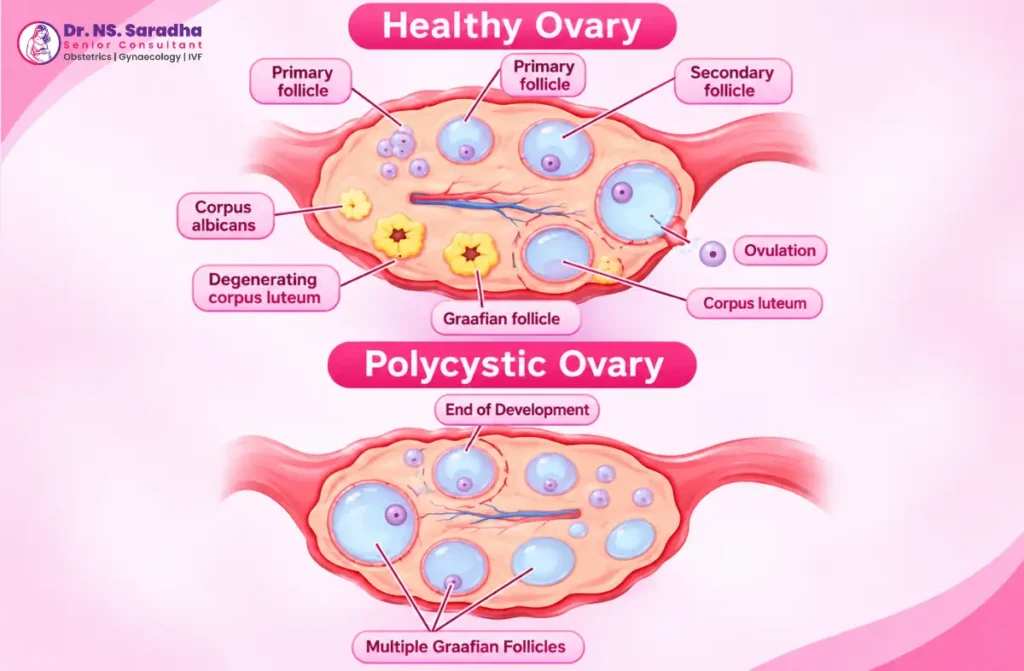
Follicles grow in stages. They start as dormant primordial follicles, then become primary and secondary follicles. At the antral stage, a small pocket of fluid forms inside the follicle. This fluid is what makes it visible on a scan.
Antral follicles are small, usually about 2 to 9 mm wide. At the start of each cycle, a group of them is switched on to grow by a hormone called FSH. Usually only one of them goes on to release an egg.
How Is Antral Follicle Count Measured?
The count is done with a transvaginal ultrasound. A thin probe is gently placed in the vagina, which gives a clear view of both ovaries. The doctor counts the follicles in each ovary and notes their size. The scan takes only a few minutes. Most women feel mild pressure but no real pain.
When Is the Best Time to Check Follicle Count?
The best time is early in the cycle, usually on day 2 to day 5. Day 1 is the first day of full period bleeding. At this time, the small follicles are easiest to see and count. If your periods are irregular, your doctor will choose a suitable day. The count can change slightly from one month to the next, so one scan is not the full story.
What Is the Normal Follicle Count According to Age?
Because how many follicles are normal in each ovary changes with age, the same number can mean different things for different women. The ranges below are approximate and come from clinical studies, including studies of Indian women. Doctors use normal AFC by age as a guide only. No universal age-based cut-off applies to every woman.
Normal Follicle Count Below 30 Years
Women in their twenties usually have the highest counts. Many have about 15 to 30 antral follicles in total. A count in this range is common and usually reassuring. Counts above this range may be seen with PCOS or polycystic-looking ovaries.
Normal Follicle Count Between 30 and 35 Years
The count starts to ease slowly in the early thirties. Many women under 35 still fall in the 15 to 30 range. There is no sudden drop at age 30. The change is gradual, and it differs from one woman to another.
Normal Follicle Count Between 35 and 40 Years
The decline becomes faster after 35. A total of about 10 to 15 follicles is typical at this age. Egg quality also changes with age, so the number alone does not tell the whole story. A count a little above or below this range does not mean high or low fertility by itself.
Normal Follicle Count Above 40 Years
Between 40 and 44, counts often fall to about 5 to 10. After 44, they are often below 5. Pregnancy can still happen, but the chance per cycle is lower because both egg number and egg quality are reduced. Women in this age group are usually advised to seek a fertility review early rather than wait.
What Does a Low Follicle Count Mean?
A low antral follicle count means fewer small follicles are seen on the scan. It is often called a low ovarian reserve. It suggests that fewer eggs may be left, but it does not show how good those eggs are.
Several things can lead to a low count:
- Increasing age, which is the most common reason
- Surgery on the ovaries, such as removal of a cyst or endometriosis surgery
- Cancer treatments such as chemotherapy or pelvic radiation
- Smoking, which can speed up the loss of eggs
- A family history of early menopause
- No clear reason, which is also common
To understand a low count, doctors look at your age, cycle pattern and history. They may repeat the scan and add an AMH blood test and other hormone tests. A low count does not automatically mean infertility. You need only one healthy egg each cycle to conceive. However, a low count means your time window may be shorter, so early advice helps.
What Does a High Follicle Count Mean?
A high follicle count in ovaries usually means more than 20 small follicles in total. Some reports use 20 to 30 as the high range. This is often seen in younger women. It can be normal, and it can also point to PCOS.
Multiple Follicles in Both Ovaries
Sometimes a scan report says both ovaries have many small follicles, often described as a “string of pearls”. Doctors call this polycystic ovarian morphology. It means many follicles began to grow but stopped before one became ready to ovulate. Many women with this finding have regular periods and no health problems.
High Follicle Count and PCOS
A high count does not confirm PCOS. PCOS is diagnosed when at least two of three features are present: irregular or missing ovulation, signs of high male hormones (such as acne or extra hair growth, or raised levels in blood tests), and polycystic-looking ovaries on a scan. The 2023 international PCOS guideline sets the scan cut-off at 20 or more follicles in at least one ovary when a modern, high-quality probe is used. Follicle count alone can never diagnose PCOS. You can read more on our page about PCOS and hormonal disorders.
Does a High Follicle Count Mean Better Fertility?
Not always. Many follicles do not mean many ready eggs. If follicles keep stalling and no egg is released, ovulation may be irregular, and this can make it harder to conceive. During IVF, a very high count also needs careful medicine dosing, because the ovaries can react too strongly. A healthy count is about balance and regular ovulation, not just a bigger number.
How Do Ovarian Follicles Grow During the Menstrual Cycle?
Several follicles start growing in each cycle, but usually only one releases an egg in a natural cycle. The rest fade away. Here is how it unfolds.
Early Follicular Development
Your period marks day 1. Around this time, FSH rises and wakes up a group of antral follicles. They begin to grow and make oestrogen, which also builds up the lining of the womb.
Dominant Follicle Selection
By the end of the first week, one follicle pulls ahead. It grows faster and makes more oestrogen. This is called the dominant follicle. The other follicles in the group stop growing and fade.
Follicle Growth Before Ovulation
The dominant follicle keeps growing over the next several days. Doctors can track its size with repeat ultrasound scans. As it nears full growth, oestrogen levels rise sharply.
Egg Release During Ovulation
A surge of another hormone, LH, signals the follicle to open and release its egg. This usually happens within about 24 to 36 hours of the surge. In a typical 28-day cycle, ovulation falls around day 14, but the timing differs from woman to woman. The empty follicle then changes into a structure that makes progesterone, which supports early pregnancy.
What Is the Normal Follicle Size for Pregnancy?
Small antral follicles and mature follicles are very different in size. Antral follicles measure about 2 to 9 mm early in the cycle. Before ovulation, the dominant follicle grows much larger. It usually reaches about 18 mm or more, and the average is around 22 to 24 mm.
Follicle size for pregnancy is checked with follicle monitoring scans. These scans are often started around day 9 or 10 of the cycle and repeated every day or two. The doctor measures the dominant follicle and the womb lining, then estimates when ovulation may happen.
Size alone does not give the full answer. A follicle of the right size can still hold an immature egg. Sometimes a follicle grows but does not release its egg. So follicle size does not confirm egg maturity, and it does not guarantee pregnancy.
How Is Follicle Count Checked?
Doctors use a scan and blood tests together. Each one shows a different part of your reproductive health.
Transvaginal Ultrasound Scan
This scan shows the number of follicles, their size and the size of each ovary. It can also show cysts, fibroids or other changes that affect fertility. If a vaginal scan is not suitable for you, your doctor will suggest another way to check.
AMH Blood Test
AMH stands for anti-Mullerian hormone. It is made by the small growing follicles, so it reflects your egg supply. It can usually be tested on any day of the cycle. A low AMH suggests a lower reserve, while a very high AMH is often seen with PCOS. Results are read with your age and the lab’s reference range.
Other Hormonal Tests
Your doctor may also check FSH, LH and oestrogen, usually early in the cycle. Thyroid hormone and prolactin tests are common too, because they can affect ovulation. If PCOS is suspected, male hormone levels may be checked. Together, these tests give a fuller view of your ovarian reserve and fertility.
Can You Improve Your Follicle Count Naturally?
It helps to separate egg quantity from egg quality. Quantity means how many eggs you have, and it is set before birth. Quality means how healthy those eggs are, and it is shaped mainly by age and overall health. Lifestyle can support general health and ovulation, but it cannot reliably increase the number of eggs you already have. Understanding ovarian reserve and fertility starts with this fact.
These healthy habits are still worth following:
- Eat balanced meals with vegetables, fruits, whole grains, pulses and protein. Our PCOS diet plan gives simple food ideas.
- Stay active with regular moderate exercise, such as brisk walking.
- Sleep well, ideally 7 to 9 hours each night.
- Avoid smoking and limit alcohol.
- Manage stress and treat conditions like thyroid problems or PCOS.
No supplement or home remedy has been shown to reliably raise follicle numbers. Please speak to your doctor before starting any supplement.
How Does Follicle Count Affect IVF Treatment?
Women often ask how many follicles are normal in each ovary before IVF, because the count helps guide treatment planning. It tells the team how your ovaries may respond to fertility medicines.
Role of Follicle Count in IVF Planning
Specialists look at your AFC, AMH, age and medical history together. This helps them choose the medicine type and dose. A low count may mean a higher dose or a different plan. A very high count needs a careful, lower-dose plan to reduce the risk of ovarian hyperstimulation syndrome (OHSS), a strong over-response of the ovaries. The follicle count for IVF is a planning tool, not a prediction of the result.
Follicle Monitoring During Ovarian Stimulation
During stimulation, several follicles grow together. Repeat scans track their size, and blood tests may check hormone levels. The doctor adjusts the medicine based on how you respond. When several follicles reach about 18 mm, a trigger injection is given to help the eggs mature fully.
Relationship Between Follicle Count and Egg Retrieval
Egg retrieval is usually done about 36 hours after the trigger injection. The number of follicles does not always equal the number of mature eggs collected. Some follicles may hold immature eggs, and a few may be empty. A rare condition called empty follicle syndrome can occur, but it does not always mean a fertility problem.
Does Follicle Count Predict IVF Success?
Follicle count and AMH help predict how many eggs you may produce. They do not predict your chance of a healthy baby on their own. Age, egg quality, embryo quality and the health of the womb also play major roles. No doctor can promise IVF success from a follicle count.
When Should You Consult a Gynaecologist or Fertility Specialist?
A fertility check can be helpful at different points in life. You may benefit from a review in these situations:
- You are under 35 and have been trying to conceive for 12 months without success
- You are 35 or older and have been trying for 6 months
- You are 40 or older and planning pregnancy, ideally before you start trying
- Your periods are irregular, very infrequent, or missing
- You have PCOS, endometriosis, fibroids, or have had ovarian surgery
- You have had repeated miscarriages
- You plan to delay pregnancy and want to know about your ovarian reserve
Irregular cycles are worth checking early, because they can be a sign of ovulation problems. Your age, cycle history and past health all shape what advice is right for you. Two women with the same follicle count can need very different care.
Why Choose Dr. N.S. Saradha for Fertility and Gynaecological Guidance?
Dr. N.S. Saradha is a Senior Consultant in Obstetrics, Gynaecology and IVF in Chennai, with over 30 years of experience in women’s healthcare. Her fertility services include fertility consultation and assessment, ovulation induction and monitoring, IUI, IVF, fertility preservation options, and hormonal evaluations. You can read more about her background on the About Dr. N.S. Saradha page.
A personal fertility evaluation matters because a follicle count only makes sense when read with your age, hormones and history. Understanding your ovarian reserve and reproductive health early gives you more choices. Learn more on our pages for fertility and reproductive medicine and fertility treatment in Chennai. If irregular cycles or ovarian findings worry you, our pages on menstrual disorders and ovarian conditions may help.
Conclusion
Understanding how many follicles are normal in each ovary can help you see your fertility more clearly. The antral follicle count gives a useful estimate of your ovarian reserve, but it is not a promise or a diagnosis. Age, egg quality, hormone levels and your overall reproductive health matter just as much as the number on your scan.
If you have questions about your follicle count, irregular cycles or planning a pregnancy, a personal review can give you clear answers. You are welcome to consult Dr. N.S. Saradha for gynaecological and fertility guidance.