Finding a cyst on your ovary during pregnancy can feel worrying. The reassuring part is that most cysts found at this time are harmless and are simply watched with scans. Often, a right ovarian cyst in pregnancy is picked up by chance during a routine ultrasound, even when you feel completely well. This guide explains why it forms, what symptoms to look for, how it is checked and how it is treated, so you can talk to your gynaecologist with clarity and confidence.
What Is a Right Ovarian Cyst in Pregnancy?
An ovarian cyst is a fluid-filled sac that forms on or inside an ovary. Every woman has two ovaries, one on each side of the uterus. The right ovary sits in the lower right part of the pelvis. Like the left ovary, it releases an egg each month and makes hormones such as oestrogen and progesterone.
A cyst can form on either side. When it is on the right, it is called a right-sided cyst, but the side does not change the type of cyst or the way it is treated.
Cysts are often noticed in pregnancy because most women have an early ultrasound, and the scan also shows the ovaries. A cyst that might have gone unnoticed in daily life can appear on the screen. Doctors often find a right ovarian cyst in pregnancy only because of this scan, and not because of any complaint.
Most of these are functional cysts. They form as part of the ovary’s normal monthly cycle and are not a disease. Other types, such as dermoid cysts, cystadenomas and endometriomas, are less common. They usually do not disappear on their own, so they need closer follow-up.
What Causes a Right Ovarian Cyst During Pregnancy?
Several natural changes can lead to a cyst on the ovary while you are expecting.
Hormonal Changes During Pregnancy
Pregnancy brings a large rise in hormones, including hCG and progesterone. These hormones keep the ovaries active in the early months. Women who conceived with ovulation-inducing medicines may have enlarged ovaries with several small cysts. This usually settles on its own as the pregnancy moves forward.
Corpus Luteum Cysts
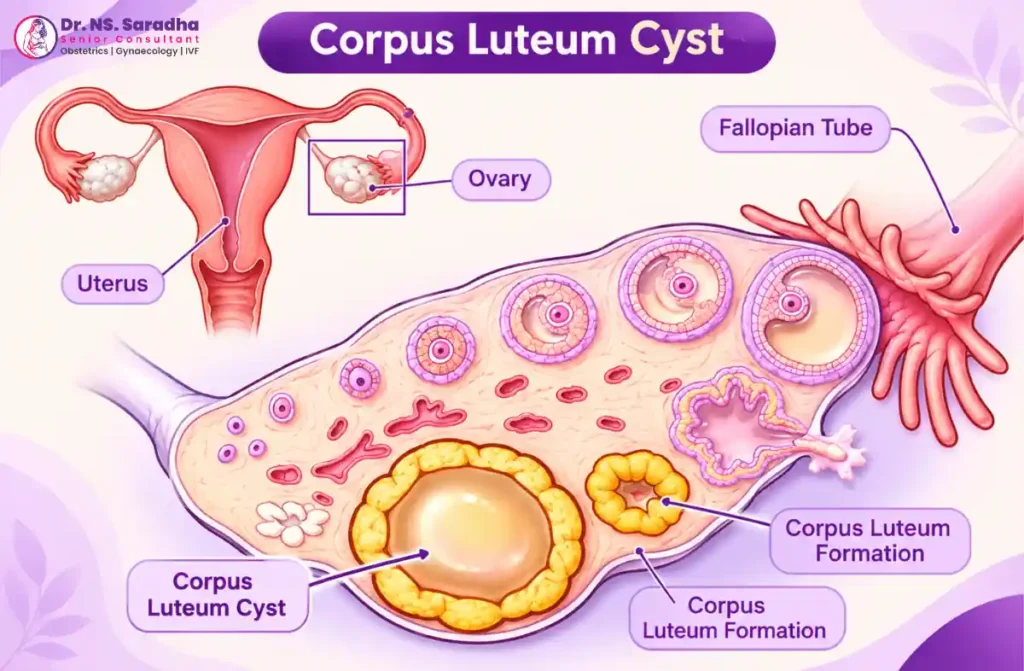
After an egg is released, the empty follicle turns into a small gland called the corpus luteum. It makes progesterone to support the early pregnancy until the placenta takes over. Sometimes this gland fills with fluid or a little blood and forms a corpus luteum cyst. Most of these shrink without any treatment.
Functional Ovarian Cysts
A follicular cyst forms when the follicle does not release its egg and keeps growing with fluid. A hemorrhagic cyst forms when there is some bleeding inside a simple cyst. Both are common types of functional cysts and often reduce in size over time.
Other Types of Ovarian Cysts
Some cysts are not linked to the monthly cycle. These include dermoid cysts, cystadenomas, endometriomas and para-ovarian cysts. They are not caused by pregnancy, but they can be found during it. They are watched more closely because they may stay or grow. Cancerous cysts are very rare in pregnancy, and scans help doctors tell the difference.
Common Symptoms of a Right Ovarian Cyst in Pregnancy
Many ovarian cysts do not cause any symptoms. Women often learn about them only from a scan. When ovarian cyst symptoms during pregnancy do appear, they may include:
- A dull ache or mild discomfort in the lower right abdomen or pelvis
- One-sided pelvic pain that comes and goes
- Bloating or a feeling of fullness in the abdomen
- Pressure on the bladder or bowel, such as passing urine more often or constipation
- Lower back pain
Larger cysts can cause more noticeable symptoms. These include visible swelling of the abdomen, constant heaviness, or pain that gets worse with movement.
The symptoms of a right ovarian cyst in pregnancy can be easy to confuse with normal pregnancy changes, such as stretching of the ligaments that support the uterus. Right-sided pain can also come from other causes, such as a urine infection or the appendix. So please do not guess the cause yourself. A scan and an examination give a clear answer.
Is a Right Ovarian Cyst Dangerous During Pregnancy?
In most women, a right ovarian cyst in pregnancy turns out to be harmless. The risk depends on the cyst’s size, its appearance on the scan and the symptoms it causes. Here is how it works in different situations.
Small and Simple Ovarian Cysts
A small, simple cyst has thin walls, contains only fluid and causes no pain. These are the most common type in pregnancy. They are usually safe to watch with follow-up scans, and many shrink or disappear by themselves.
Large Ovarian Cysts
A large ovarian cyst in pregnancy, often described as more than about 8 to 10 cm, is more likely to cause pressure symptoms, twisting or rupture. Medical case reports show that even a very large cyst found early can be studied with ultrasound and MRI. If needed, a planned operation can be arranged. The plan is always based on the individual woman and her pregnancy.
Ovarian Cyst Torsion During Pregnancy
Torsion means the ovary twists on the tissue that holds it, which reduces its blood supply. It is uncommon, but it is more likely with larger cysts. It can cause sudden, severe pain on one side, sometimes with nausea or vomiting. This needs prompt medical care.
Ovarian Cyst Rupture During Pregnancy
Rupture means the cyst wall breaks and the fluid leaks out. It may cause sudden pain. Small ruptures often settle with rest and pain relief under medical advice. Heavy pain, dizziness or bleeding needs urgent assessment.
How Is a Right Ovarian Cyst Diagnosed During Pregnancy?
Doctors look at the cyst’s size, appearance, position and growth. Several steps help in ovarian cyst diagnosis during pregnancy.
- Ultrasound Examination : Ultrasound is the first and most useful test. It uses sound waves, not radiation, so it is safe for you and your baby. It shows the size of the cyst, the thickness of its wall, whether it holds only fluid, and whether it contains any solid parts.
- MRI for Further Evaluation If the ultrasound is not clear, or the cyst is large, your doctor may suggest an MRI. It uses magnets and no radiation. It gives a detailed picture of where the cyst comes from and what it contains. This helps in planning care.
- Clinical Assessment and Additional TestsYour doctor will ask about your symptoms and examine your abdomen. Some blood tests may be advised. Tumour markers such as CA-125 are of limited value in pregnancy because they can rise in a normal pregnancy too. So doctors read these results carefully, along with the scan. Repeat scans show whether the cyst is shrinking, staying the same or growing.
Treatment Options for Right Ovarian Cysts During Pregnancy
There is no single plan for every woman. Ovarian cyst treatment during pregnancy depends on the cyst’s features, your symptoms and your stage of pregnancy. Not every cyst needs treatment or surgery.
Regular Monitoring and Follow-Up Scans
Small cysts that look simple and cause no trouble are usually watched with scans at planned intervals. This lets your doctor see any change early.
Conservative Management
Conservative management means watching and waiting without a procedure. Many functional cysts shrink by the second trimester. A cyst that remains after about 16 weeks, grows, or shows unusual features needs a closer look.
Medication and Symptom Management
If you have mild pain, your doctor may suggest safe pain relief. Please do not take any medicine on your own, because not every medicine is suitable in pregnancy.
Surgical Treatment When Necessary
Surgery may be advised when a cyst is large, keeps growing, does not go away, twists, bleeds or ruptures, or looks suspicious on scans. When surgery can be planned, the second trimester is generally preferred. Emergency surgery can be done at any stage if needed. The method, either keyhole (laparoscopic) or open surgery, depends on the cyst’s size, the stage of pregnancy and the surgeon’s experience.
Can a Right Ovarian Cyst Affect the Baby During Pregnancy?
In many cases, a right ovarian cyst in pregnancy is only monitored, and the pregnancy continues with regular antenatal care. The cyst sits on the ovary, outside the uterus, so it does not touch the baby directly.
A few points are considered for both mother and baby. A large cyst may cause pain or pressure. Rarely, it can lead to twisting or rupture. Surgery during pregnancy also carries its own risks, such as early labour, so doctors weigh the benefits and risks carefully before suggesting it.
No one can promise a particular outcome, but regular antenatal visits help catch any change early. You can read more about pregnancy care and obstetrics and high-risk pregnancy care on our website.
When Should You Consult a Gynaecologist?
Please book a check-up if you notice:
- Lower abdominal or pelvic pain that continues or becomes stronger
- A feeling of swelling, heaviness or pressure in the lower abdomen
- New trouble passing urine or stools
- Pain along with fever
Sudden, severe abdominal or pelvic pain needs urgent medical assessment. Please go to a hospital straight away if the pain comes with vomiting, faintness or dizziness, or vaginal bleeding. Do not wait for it to pass.
How Is a Right Ovarian Cyst Managed During Different Stages of Pregnancy?
Care changes with the stage of pregnancy and with the scan findings. There is no fixed timeline that fits every woman.
First Trimester
A cyst found in early pregnancy is often a corpus luteum cyst, and most settle by themselves. An ovarian cyst in early pregnancy is usually watched with a repeat scan. Surgery is kept for cases with strong reasons, such as severe pain or suspected twisting.
Second Trimester
By this time, most functional cysts have shrunk or gone. A cyst that is still present, is growing or looks unusual is studied further. If an operation is needed and can be planned, this is usually the preferred period.
Third Trimester
Surgery is generally avoided in the last months because the large uterus makes it harder and may raise the chance of early labour. Many cysts are watched until after delivery. In some women, the doctor may plan to remove the cyst during a caesarean. Emergencies are treated whenever they occur.
Why Choose Dr. N.S. Saradha for Gynaecological Guidance?
Dr. N.S. Saradha is a Senior Consultant in Obstetrics, Gynaecology and IVF with over 30 years of experience in women’s healthcare. Her work covers prenatal care, high-risk pregnancy, postnatal recovery and general gynaecology. She also performs minimally invasive procedures, including laparoscopic procedures. You can read more about her on the About Dr. N.S. Saradha page.
Every cyst is different, which is why individual assessment matters. A proper diagnosis, planned follow-up scans and careful pregnancy monitoring help each woman get a plan that suits her. You can also learn about ovarian conditions and pregnancy related conditions we care for.
Conclusion
The most important points about a right ovarian cyst in pregnancy are early identification, appropriate monitoring and a plan made for you. Most cysts are harmless and need only follow-up scans, while a few need closer care or a procedure. Every pregnancy is different, so your doctor’s guidance matters more than any general advice. If you have been told you have a cyst, or you have symptoms that worry you, book a consultation with Dr. N.S. Saradha through the Contact Us page for a careful assessment and clear guidance.