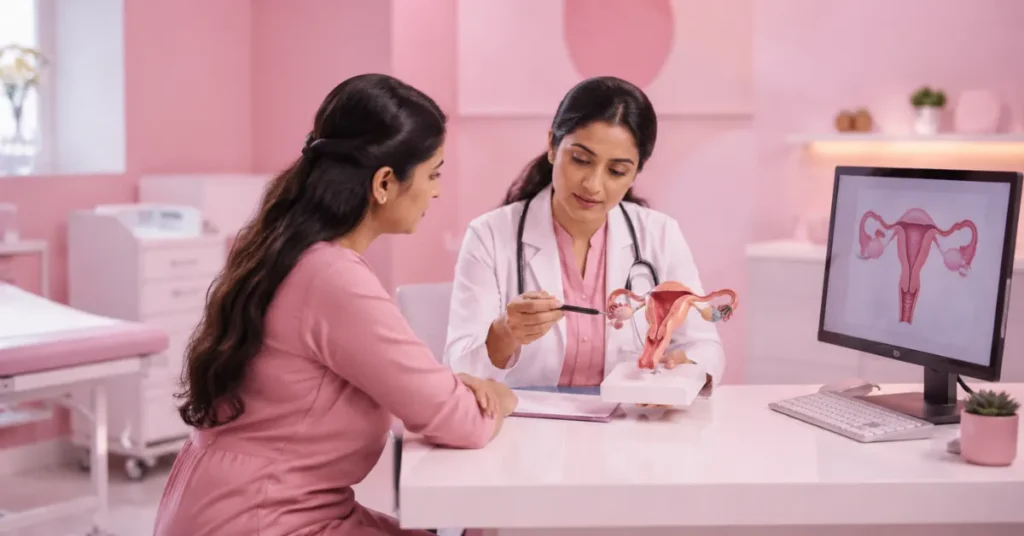

Functional cysts are the most common type of ovarian cyst, and the good news is they are almost always harmless. They form as a natural part of the menstrual cycle when a follicle a tiny sac in the ovary that holds a developing egg either does not release the egg properly or does not dissolve after ovulation.
There are two main types. A follicular cyst forms when the follicle does not burst and release the egg, and instead keeps growing. A corpus luteum cyst forms after the egg is released, when the follicle seals itself and fills with fluid. Both types usually resolve on their own within a few menstrual cycles.
Most functional cysts cause no symptoms at all and are found incidentally during a routine scan. Some women may experience a dull ache or fullness in the lower abdomen, especially around the time of their period. In rare cases, a cyst can twist or rupture, which causes sudden, sharp pain that needs prompt medical attention.
As an experienced gynecologist in Vadapalani, Dr. N.S. Saradha monitors functional cysts with regular ultrasound scans and advises treatment only when the cyst is large, persistent, or causing discomfort. In most cases, watchful waiting with periodic follow-up is all that is needed.
An endometrioma is a type of cyst that forms when endometrial tissue the lining that normally grows inside the uterus starts growing on or inside the ovary. During each menstrual cycle, this tissue bleeds just as it would inside the uterus, but because the blood has nowhere to go, it collects inside the ovary and forms a cyst. Over time, this blood becomes thick and dark which is why these are often called chocolate cysts.
Endometriomas are directly linked to endometriosis, a condition in which uterine lining tissue grows outside the uterus. They are one of the more common reasons for pelvic pain and difficulty conceiving in women of reproductive age.
Symptoms to watch for include:
It is important to note that some women with endometriomas feel very little pain, while others experience significant discomfort. The size of the cyst does not always match the severity of symptoms.
Treatment depends on the size of the cyst, the woman's symptoms, and whether she is trying to conceive. Dr. N.S. Saradha offers both medical and surgical options. For women planning pregnancy, laparoscopic surgery to remove the cyst while preserving the ovary is often recommended. As a skilled gynecologist in Saligramam and Vadapalani, she takes particular care to protect ovarian tissue and fertility during any surgical procedure.
Dermoid cysts, also known as mature cystic teratomas, are a unique type of ovarian cyst. They form from cells that have the potential to develop into various tissue types which is why they can sometimes contain hair, skin cells, fat, or even small fragments of bone or teeth. This might sound alarming, but dermoid cysts are almost always benign (non-cancerous).
They can develop at any age, including in young girls, and are often discovered during a routine pelvic scan done for an unrelated reason. Many women with a dermoid cyst feel no symptoms at all. However, larger cysts can cause a dull, persistent ache in the lower abdomen.
The main risk with dermoid cysts is ovarian torsion when the weight of the cyst causes the ovary to twist. This is a medical emergency that requires prompt surgery. For this reason, dermoid cysts that are large or growing are usually recommended for removal.
Surgery is the primary treatment, and Dr. N.S. Saradha performs laparoscopic removal whenever possible a minimally invasive approach that means a shorter hospital stay, smaller incisions, and a faster return to daily life. For women who come to her for ovarian conditions treatment in Chennai, she always tailors the surgical plan to protect as much healthy ovarian tissue as possible.
Ovarian torsion is a condition in which the ovary and sometimes the fallopian tube twists around the ligaments that hold it in place. This twisting cuts off the blood supply to the ovary, which can cause rapid, severe pain and, if not treated quickly, permanent damage to the ovary.
Ovarian torsion is considered a gynaecological emergency. It most often happens when an ovarian cyst or enlarged ovary makes the organ heavy enough to twist on its own axis. Occasionally, it can occur in a normal-sized ovary as well.
Common symptoms include:
If you experience sudden, severe pelvic pain, it is important to seek medical care right away. Time matters in ovarian torsion the sooner treatment is given, the better the chance of saving the ovary.
Surgery is required to untwist the ovary and restore blood flow. In most cases, the ovary can be saved if treatment is given promptly. Dr. N.S. Saradha performs laparoscopic surgery for ovarian torsion, using a minimally invasive technique to untwist the ovary and address any cyst that may have caused the problem. As a trusted gynecologist in Vadapalani, she is equipped to handle urgent gynaecological cases with both speed and care.
Borderline ovarian tumours are a group of tumours that sit in the middle ground between a benign cyst and an ovarian cancer. They grow slowly and do not invade surrounding tissue the way cancerous tumours do but they are also not completely benign and do need to be taken seriously and treated appropriately.
These tumours are most commonly found in women between the ages of 20 and 50. They often cause no symptoms in their early stages, and are frequently discovered during a routine ultrasound scan or fertility investigation. In some cases, they may cause abdominal bloating, pelvic discomfort, or a feeling of fullness.
The diagnosis of a borderline tumour is confirmed by pathology after the tissue is examined. This is why surgery specifically to remove the tumour and send it for analysis is the key step in both diagnosis and treatment.
Dr. N.S. Saradha follows evidence-based protocols for managing borderline ovarian tumours. For women who wish to preserve their fertility, conservative surgery that removes the tumour while keeping the ovary and uterus intact is often possible. For women who have completed their family, more definitive surgery may be the better option. Ongoing follow-up is essential after treatment, and Dr. Saradha ensures her patients are supported through every step of that journey.
Polycystic ovaries (PCO) refers to a finding on an ultrasound scan where the ovaries contain a large number of small, undeveloped follicles often described as looking like a string of pearls. Having polycystic ovaries on a scan does not automatically mean a woman has PCOS. PCOS, or Polycystic Ovary Syndrome, is a broader hormonal condition that includes the ovarian finding along with other symptoms like irregular periods and elevated androgen (male hormone) levels.
PCOS is one of the most common hormonal conditions in women of reproductive age, affecting roughly 1 in 10 women. It can affect the menstrual cycle, fertility, weight, skin, and mood and its effects can vary considerably from woman to woman.
Common signs of PCOS include:
PCOS is managed rather than cured, but the right treatment can significantly improve quality of life and fertility outcomes. Lifestyle changes particularly around diet and physical activity make a meaningful difference, especially for women with insulin resistance. Medical treatment options include hormonal therapy to regulate cycles, medication to manage androgen levels, and ovulation induction for women trying to conceive.
Dr. N.S. Saradha has extensive experience managing PCOS across all life stages from teenagers experiencing irregular cycles for the first time, to women managing metabolic health in their 30s, to those seeking fertility support. As a well-regarded gynecologist in Saligramam, she creates individualised care plans based on each woman's specific symptoms, priorities, and goals
Ovarian conditions are more common than many women realise and the range is wide, from simple functional cysts that need no treatment at all, to more complex conditions that benefit from timely medical or surgical care. What they have in common is that they are all manageable with the right support.
If you have been told you have an ovarian cyst, or if you are experiencing unexplained pelvic pain, irregular periods, bloating, or difficulty conceiving, it is worth getting a proper evaluation. Early assessment makes it easier to understand exactly what you are dealing with and to make informed choices about your care.
Dr. N.S. Saradha brings over 30 years of hands-on experience to every consultation. Her expertise in laparoscopic and robotic gynaecological surgery, combined with her patient-centred approach, means that women seeking ovarian conditions treatment in Chennai are in highly capable and compassionate hands. Whether the treatment required is watchful monitoring, medical management, or minimally invasive surgery, she works closely with each patient to find the right path forward.
Functional cysts follicular cysts and corpus luteum cysts arise from normal ovulatory processes and usually resolve spontaneously within 1–3 menstrual cycles. Simple cysts under 5 cm in premenopausal women rarely need intervention; larger or persistent cysts merit closer follow-up.
An endometrioma (chocolate cyst) is an ovarian cyst formed when endometriosis tissue implants on the ovary and accumulates altered blood. They cause pelvic pain, worsen with menstruation, and can impair ovarian reserve. Surgical removal (cystectomy) or medical suppression may be recommended depending on symptoms and fertility plans.
Ovarian torsion presents with sudden-onset severe unilateral lower abdominal pain, often with nausea and vomiting. It is a surgical emergency twisting cuts off blood supply to the ovary. Ultrasound with Doppler is performed but normal flow does not exclude torsion; clinical suspicion alone may warrant diagnostic laparoscopy.
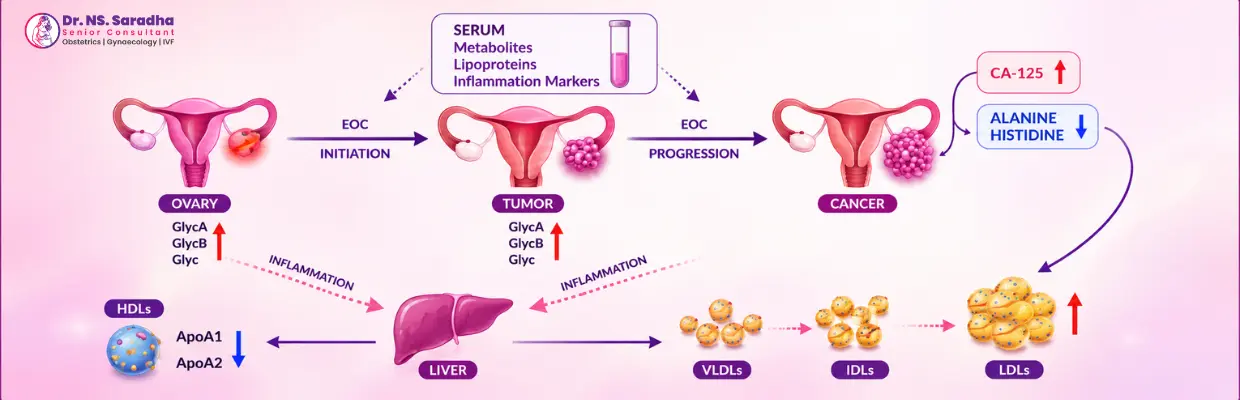
Ovarian cancer is often called a ‘silent’ disease, but symptoms do exist: persistent bloating, early satiety, pelvic or abdominal pain, and urinary urgency or frequency especially if new, frequent, and unexplained. CA-125 and pelvic ultrasound are first-line investigations; early referral to a gynaecological oncologist is essential.
Menopause is the natural cessation of periods at around age 51. POI is when ovarian function declines before age 40, with elevated FSH and oestrogen deficiency. Unlike menopause, POI is not irreversible sporadic ovulation can occur. HRT is strongly recommended to protect bone and cardiovascular health until at least the natural age of menopause.
Take the first step toward better women’s health with expert, compassionate care at Dr. N.S. Saradha Women’s Health Centre. Get accurate diagnosis, advanced treatments, and personalized care designed to support safe recovery and long-term wellness at every stage of life.